
Your PM’s Books Can Be Clean and Your Statement Still Wrong
Property management bookkeeping is usually built to keep the property manager compliant.
Not to make the owner a better asset manager.
That is the gap.
The PM can reconcile the trust account, pay vendors, collect rent, and close the month without answering the question you actually care about:
Did this property produce the NOI I think it produced?
A clean set of PM books does not automatically mean your owner statement is clean. It means the PM’s accounting system balanced.
Those are different standards.
The PM bookkeeper is solving a different job
The PM bookkeeper’s job is not to build your portfolio operating system.
Their job is to record money in and money out, keep the trust account straight, pay bills, charge fees, and produce owner statements. That matters. In many states, property management accounting rules focus on cash received, cash paid out, and owner summary statements. Washington’s property management rule, for example, describes accounting systems around cash receipts, disbursements, balances, and owner summaries.
That is a compliance view.
Your view is different.
You need to know whether a $1,350 rent charge actually became collected rent, whether the $1,215 deposit landed in the bank, whether the $135 PM fee matches the agreement, whether the $400 repair had an invoice, whether the reserve movement was real, and whether the month changed the asset.
Those questions live below the statement total.
That is why an owner statement can look fine and still be wrong for you.
A clean trust account is not clean NOI
Trust accounting is about custody of funds.
NOI is about property performance.
Those two overlap. They are not the same job.
Property management bookkeeping guides usually tell PMs to separate trust accounts, track each owner ledger, reconcile monthly, and send owner reports. Good. That is baseline hygiene. Recent trust accounting guidance also points to monthly bank reconciliation and complete documentation as the core control.
But owner performance breaks in the details.
If a renewal fee is billed as a new lease placement, the PM’s books may still balance. If a $100 reserve top up absorbs a short bank deposit, the trust account can still reconcile. If a HAP payment posts short and the tenant portion lands three days later, the statement can still close while your expected rent is not actually whole.
The failure is not always fraud.
Most of the time, it is translation loss.
The PM system speaks in statements, ledgers, fees, payables, and trust balances. The owner needs property NOI, cash flow, equity, loan impact, tax category, and exception flags. When those two views are not tied together, you become the translator.
That is the unpaid job nobody mentions when they sell you passive income.
Five lines still deserve owner eyes
You do not need to redo the PM’s bookkeeping.
You need to verify the lines that change owner cash and property performance.
Start with these five.
-
Rent collected. Do not stop at scheduled rent. Confirm what was actually collected, what is tenant portion, what is subsidy portion, and what is still open.
-
PM fees. Match the fee against the management agreement. A 10 percent fee on collected rent is not the same as a 10 percent fee on scheduled rent.
-
Leasing and renewal fees. These may be legitimate, but one wrong classification can double the cost of a tenant event.
-
Maintenance and vendor charges. Confirm the invoice exists, the vendor makes sense, the property is correct, and the category is not distorting repairs versus capital improvements.
-
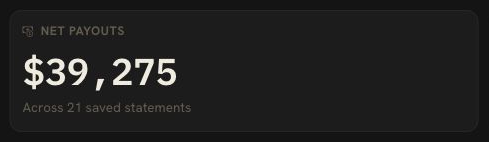
Net payout to bank deposit. This is the owner truth line. If the statement says $1,215 should be paid and the bank shows $1,115, there is a $100 question. Maybe it is timing. Maybe it is reserves. Maybe it is an error. Either way, it should not wait until tax season.
Once you verify those five lines monthly, most PM statement problems stop hiding.
The point is not to turn every owner into a bookkeeper.
The point is to stop letting the PM’s close become your only source of truth.
DoorVault turns the statement into evidence
DoorVault is built for the owner side of this problem.
You forward the PM email to Knox or upload the owner statement. Knox reads the statement, extracts the line items, links them to the right property, proposes the transactions, files the document, and checks the payout against the bank deposit.
That is the part most spreadsheets never solve.
They store numbers. They do not prove them.
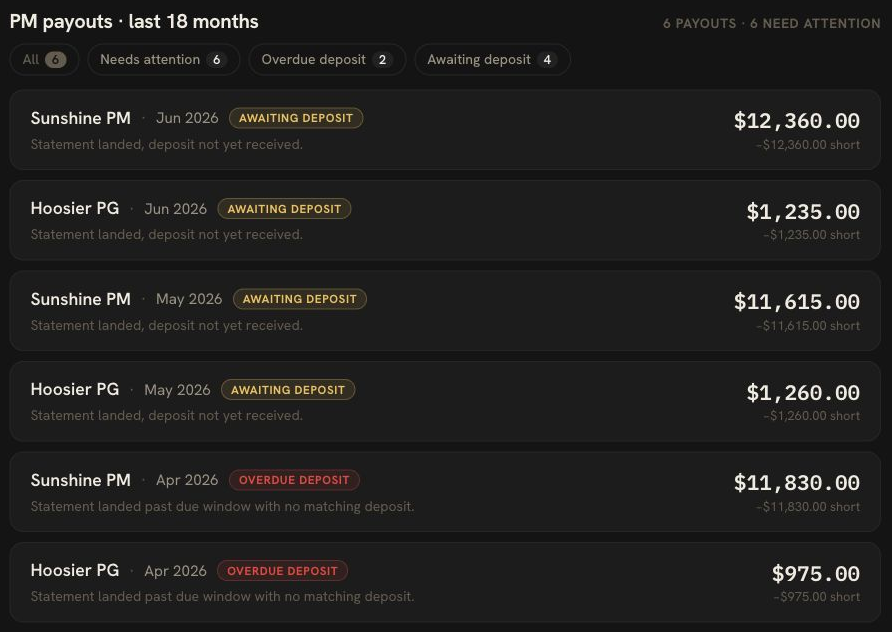
DoorVault keeps the PM statement, the transaction, the bank deposit, the property, the document, and the monthly performance view tied together. If the payout has not landed, the status is visible. If the deposit is overdue, it gets flagged. If the same PM fee pattern shows up every month, Knox learns it. If a line looks wrong, you review it before it touches your books with Trust Knox off, or let Knox apply clean matches automatically with Trust Knox on.
The same owner record carries the rest of the month too.
The repair invoice stays with the charge. The lease or HAP record explains the expected rent. The mortgage payment split keeps principal out of NOI. The entity and CPA records stay ready for tax season. The loan and equity views keep the asset decision connected to the books.
Not a feature tour.
The month, tied together.
The boring monthly close is the win
The best monthly owner close is boring.
Statement came in. Rent matched. PM fee matched. Maintenance had invoices. Reserve movement was explained. Bank deposit landed. Property P&L updated. Documents filed. No mystery line survived the month.
That should take minutes, not a Sunday afternoon.
If you want the deeper checklist, read our guide on how to reconcile an owner statement when you use a property manager. If you want the faster smoke test, use the property manager statement verification guide.
The big shift is this:
Do not ask whether your PM’s books are clean.
Ask whether your owner numbers are trustworthy.
Those are not the same question.
Start free. 2 properties. No credit card. https://doorvault.app
FAQs
What is property management bookkeeping?
Property management bookkeeping is the work of recording rent, fees, expenses, deposits, owner balances, vendor bills, and owner distributions for rental properties managed by a PM. The PM version centers on trust accounting, owner ledgers, and compliance.
Why can owner statements still be wrong?
An owner statement can balance inside the PM’s system while still hiding an owner problem. A wrong fee basis, quiet reserve change, missing invoice, short rent item, or payout mismatch can all survive a clean close unless the owner verifies the statement against the bank deposit and supporting documents.
How often should owners reconcile PM statements?
Monthly. The PM’s asset decisions may be quarterly or annual, but the money errors happen when the statement posts. A renewal fee, duplicate repair charge, short payout, or missing late fee should be caught while the month is fresh.
What does DoorVault check?
DoorVault reads the PM statement, extracts rent, fees, repairs, reserves, and net payout, files the PDF, links supporting documents, and matches the expected payout against the bank deposit. Knox flags the exceptions so the owner reviews the catch instead of rebuilding the month.
Sources
Property management accounting rules and owner statement expectations vary by state, but the pattern is consistent across Washington’s property management accounting rule, property management bookkeeping guidance from Buildium and James Moore, trust accounting guidance from Yardi Breeze and Rentvine, and owner reporting guidance from DoorLoop.