
How to Verify Property Manager Statements Without Becoming the Bookkeeper
If you are trying to figure out how to verify property manager statements, start with one uncomfortable fact.
The statement can be clean, on time, and still wrong.
That is the owner problem.
Not whether the PDF arrived.
Whether the money story inside it is real.
Most investors do not get burned by one dramatic fraud headline.
They get burned by 9 small things nobody checked.
A renewal fee that should not be there.
A reserve top up that quietly absorbs the missing cash.
A maintenance line with no invoice attached.
A net deposit that is close enough to feel fine, but not close enough to be right.
That is how a 10 door portfolio turns into a second job without anybody admitting it.
If the statement looks complete, that is usually the trap
A monthly owner statement gives the impression of closure.
Rent in.
Fees out.
Owner draw sent.
Month done.
Yeah, that is the trap.
The statement is your property manager’s version of what happened.
It is not proof.
Proof lives in 4 places:
- The owner statement
- The real bank deposit
- The supporting invoices and work orders
- The agreement that says what the PM was allowed to charge in the first place
Miss one of the 4 and the month gets fuzzy fast.
This is why owners keep feeling like they should trust their PM and still cannot fully relax.
The problem is not trust.
The problem is verification.
The market keeps acting like owner reporting is a communication problem.
It is not.
It is a source-of-truth problem.
One recent investor thread said it plainly: the monthly statements showed numbers, but not whether the numbers were right. That is the whole issue. If all you can see is the summary, you are auditing a story, not the underlying money movement.
If you want the deeper playbook version first, read our direct guide on how to verify your property manager. This post is the faster owner side checklist for the monthly close itself.
The 4 numbers that matter before you read a single line item
Do not start with the whole statement.
Start with 4 anchor numbers.
They tell you whether the month deserves a quick pass or a real audit.
1. Gross rent collected
Does it match the lease reality for that property?
If rent should be $1,450 and the statement shows $1,300, you need the reason before you read anything else.
2. PM fee math
If your agreement says 10 percent and rent collected is $2,000, the management fee should not be $235.
That is not close enough.
That is 11.75 percent.
3. Reserve movement
If the owner draw is lower than expected, reserve movement is usually where the missing cash is hiding.
Reserves are not evil.
Invisible reserves are.
4. Net owner deposit
If the statement says $1,842.26 and the bank says $1,742.26, you do not have a rounding issue.
You have an unanswered question.
Those 4 numbers let you read the month with intent instead of staring at 28 line items like they are supposed to explain themselves.
This also separates investor reporting from operator reporting.
The operator needs activity.
The investor needs exceptions.
That is why the owner side workflow should be short, boring, and the same every month.
The 15 minute verification loop that catches most leaks
This is the loop.
Same property.
Same month.
Same order.
No heroics.
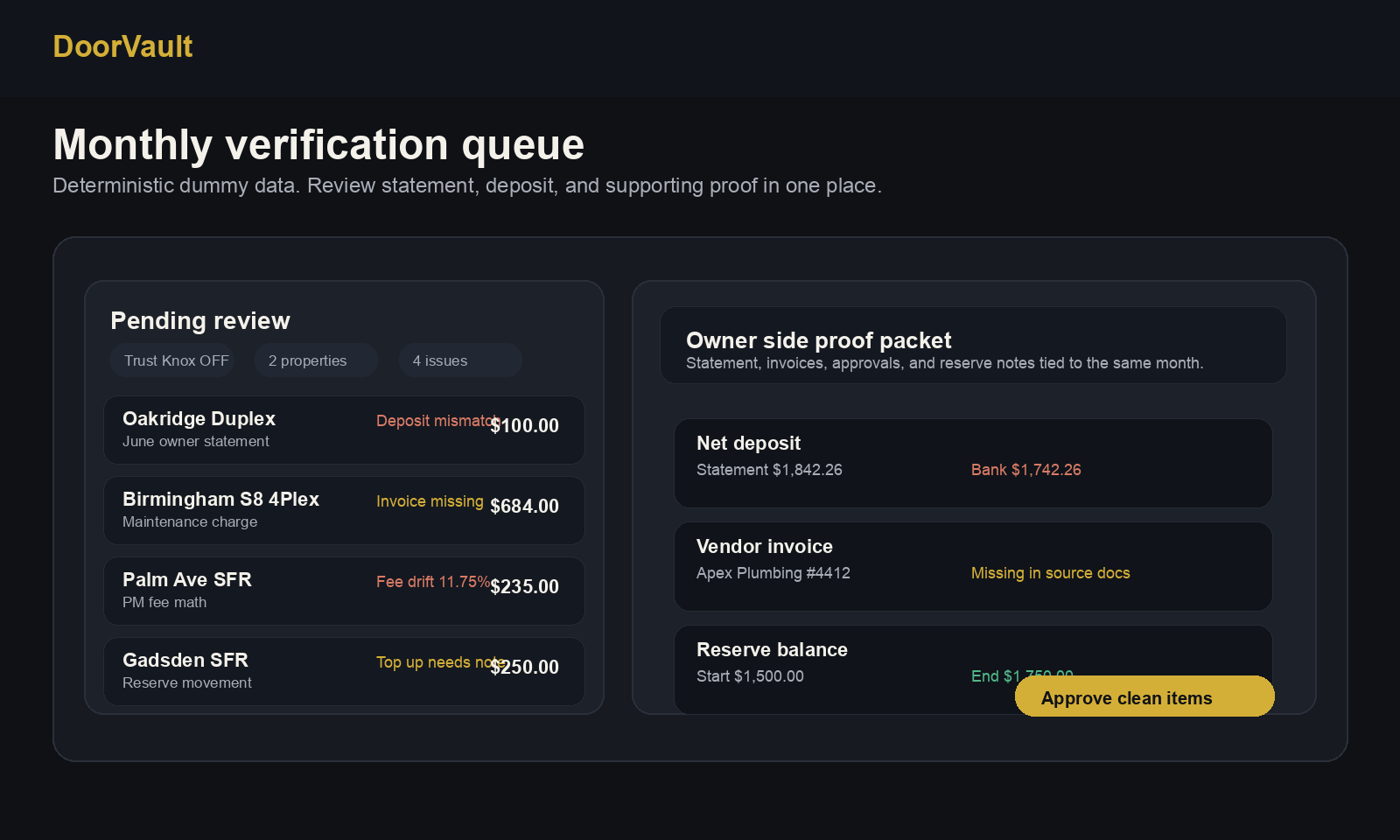
Step 1: Match the net deposit first
Do not start with the maintenance section.
Start with the cash that actually landed.
If the owner statement and bank deposit disagree, every other number becomes suspect until you explain the gap.
Step 2: Spot check every large maintenance item
Pick a threshold and stop negotiating with yourself.
$250. $500. $1,000.
Whatever fits your portfolio.
Anything above that threshold needs an invoice, a vendor name, and a date that makes sense.
If the statement says “repairs: $684” and nothing else, that is not documentation.
That is a mood.
Step 3: Recalculate the fee lines
Management fee.
Lease renewal.
Leasing fee.
Coordination fee.
Admin fee.
Owners lose money here because every charge sounds plausible in isolation.
Run the math anyway.
Step 4: Treat reserves as a balance, not an expense
Beginning reserve.
Reserve added.
Reserve used.
Ending reserve.
If the ending reserve cannot be walked from start to finish in 30 seconds, the statement is not clean enough yet.
Step 5: Save the proof packet that month
Owner statement.
Invoices.
Approval notes.
Any insurance, inspection, or lease document that affected the month.
That packet is what your CPA wants later.
It is also what you want if you ever need to challenge a charge, compare PMs, or fire one.
If you want the bank-match version of this workflow, pair this with our full guide to owner statement reconciliation.
The 3 leaks that compound quietly, fees, reserves, and unlabeled maintenance
Big fraud stories get attention.
Small recurring leaks do the real damage.
Three show up over and over.
Fee drift
A PM starts at 8 percent, then sneaks in a renewal fee, a coordination fee, a postage fee, and suddenly the effective drag is 10.5 percent.
Nothing looks insane.
Together, it is a rent cut.
Reserve fog
The statement technically balances, but the owner draw is lower because reserves moved again, and nobody explains whether that was a one time top up or the new normal.
Unlabeled maintenance
“Repairs $400” is not a line item.
It is a confession that nobody expects you to ask the next question.
The faster way to catch these three is not more spreadsheet labor.
It is better source control.
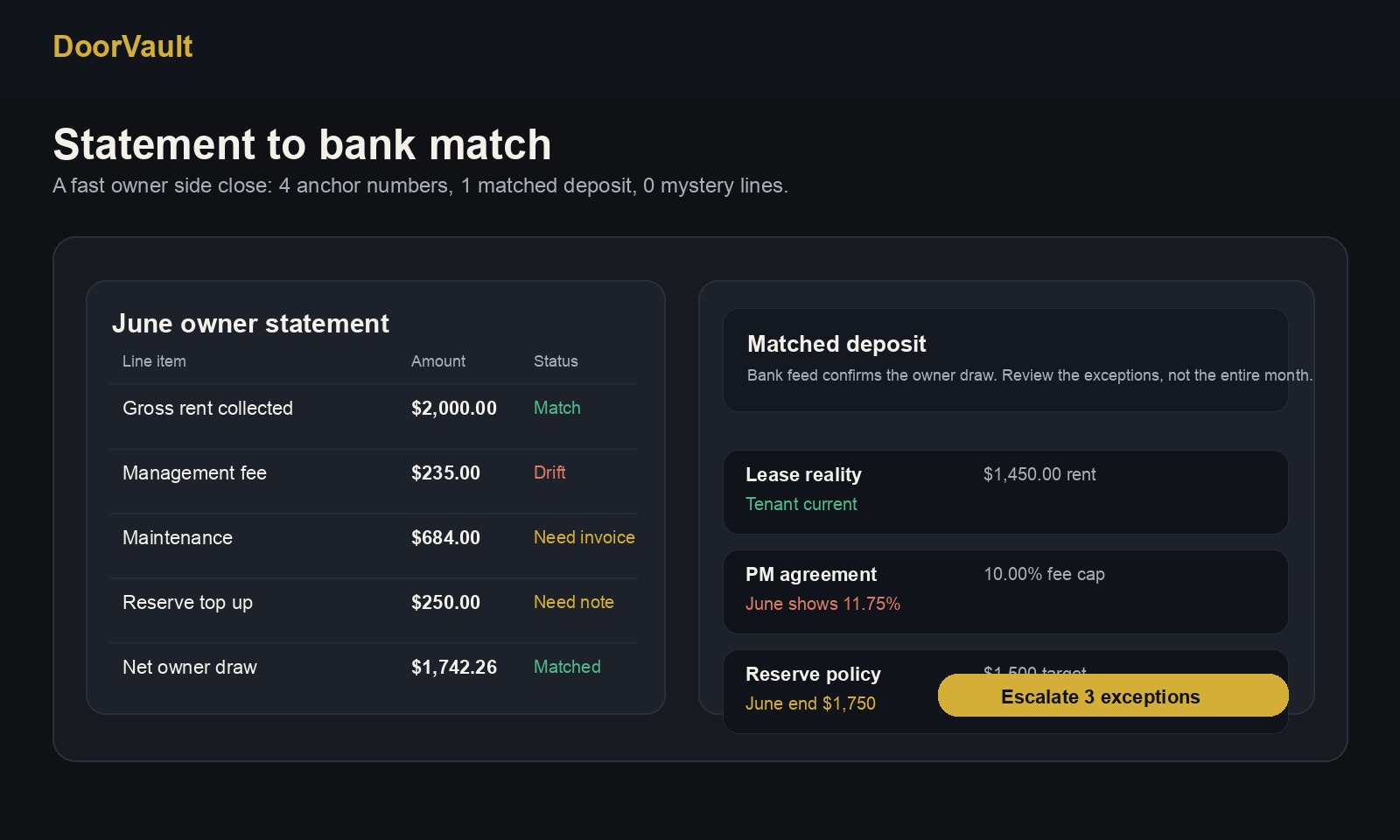
This is also where DoorVault has to show up as more than one feature.
PM statement processing reads the statement itself.
Knox inbox and cloud sync pull in the invoices, renewals, and stray docs that explain the month.
Bank reconciliation ties the statement to the actual deposit.
The Activity Log preserves who changed what and why.
PM Report Card helps you see whether one manager is consistently leaking more money than another.
The Portfolio Dashboard and per-property P&L keep the monthly cleanup tied to the actual owner questions, NOI, cash flow, equity, and return.
Schedule E export and the CPA Portal mean the same verified month becomes tax output later instead of a second cleanup project in March.
If maintenance fees are your recurring pain specifically, this pairs well with our post on property manager maintenance markups.
DoorVault should remove the second job, not give you a prettier second job
Eduardo’s portfolio is 10 doors across 3 states.
4 Section 8 in Birmingham.
4 in Florida.
1 in South Carolina.
1 more in Alabama.
That is exactly the size where owners start lying to themselves.
“It is still manageable.”
“I know my PM.”
“I will review it at quarter end.”
Then quarter end becomes tax season and tax season becomes archaeology.
DoorVault is built for the owner side of that mess.
Knox Intelligence is AI that proposes, learns, and never touches your data without permission.
So the workflow becomes tighter:
The statement gets read.
The invoice gets filed.
The bank deposit gets matched.
The anomaly gets flagged.
The month becomes reviewable.
Trust Knox off if you want every proposed change queued for approval.
Trust Knox on if you want routine work applied instantly and the exceptions surfaced.
Either way, the point is the same.
You should be reviewing the month.
Not rebuilding it.
If you want to see the owner side system that verifies PM statements, tracks the documents behind them, keeps bank activity tied to the month, and rolls it all into one portfolio view, start free at https://doorvault.app.
FAQ
What is a property manager statement?
It is the monthly owner statement your PM sends showing rent collected, expenses, fees, reserve activity, and the amount distributed to you.
How do I verify property manager statements quickly?
Start with 4 numbers: gross rent, PM fee math, reserve movement, and the net bank deposit. Then spot check large maintenance charges against invoices and approval history.
How often should I verify a PM statement?
Monthly.
The asset decision can be quarterly.
The data integrity underneath it should be monthly.
What is the biggest mistake owners make?
Treating the owner statement like proof instead of a summary.