
Property Manager Performance Metrics: 7 Numbers Owners Should Track
Your property manager can be responsive, polite, and still hard to measure.
That is the trap.
Most property manager performance metrics are written for the manager, not the owner. They measure leasing volume, portfolio growth, maintenance ticket speed, team output, and office efficiency. Useful for the PM business. Not enough for the investor trying to answer a colder question.
Is this manager protecting the asset?
You do not need a 40 line scorecard. You need 7 numbers that connect the statement, the bank deposit, the fee agreement, the maintenance trail, the vacancy record, and the actual property outcome.
The first metric is statement timeliness
If the owner statement arrives late, every other number gets stale.
A good rule: the statement should land within the same monthly close window every time. If your PM normally sends statements by the 10th and this one lands on the 23rd, that is not just a scheduling annoyance. It means rent, repairs, reserves, and owner payout questions are all waiting in the dark.
Track 3 dates:
- The month closed.
- The statement arrived.
- The owner deposit landed.
The distance between those dates tells you how much control you really have. A 5 day gap is normal in many portfolios. A 25 day gap is a management problem, even if the final PDF looks tidy.
DoorVault reads saved PM statements, keeps them tied to the right property and month, and keeps the history visible. The point is not another document folder. The point is knowing whether the reporting rhythm is getting better or worse.
The payout has to match the bank
The net owner payout is the truth line.
If the statement says $12,360 should be sent to you and the bank shows nothing, you do not have a finished month. If the bank shows $11,860, you have a $500 question. Maybe it is a reserve top up. Maybe it is timing. Maybe the PM held funds for an invoice. Maybe it is wrong.
You need the variance number, not a feeling.
Track expected payout minus bank deposit for every PM statement. Then label the status: matched, expected only, bank only, or variance.
That one control catches more owner confusion than almost anything else, because it forces the PM statement and cash reality into the same conversation.
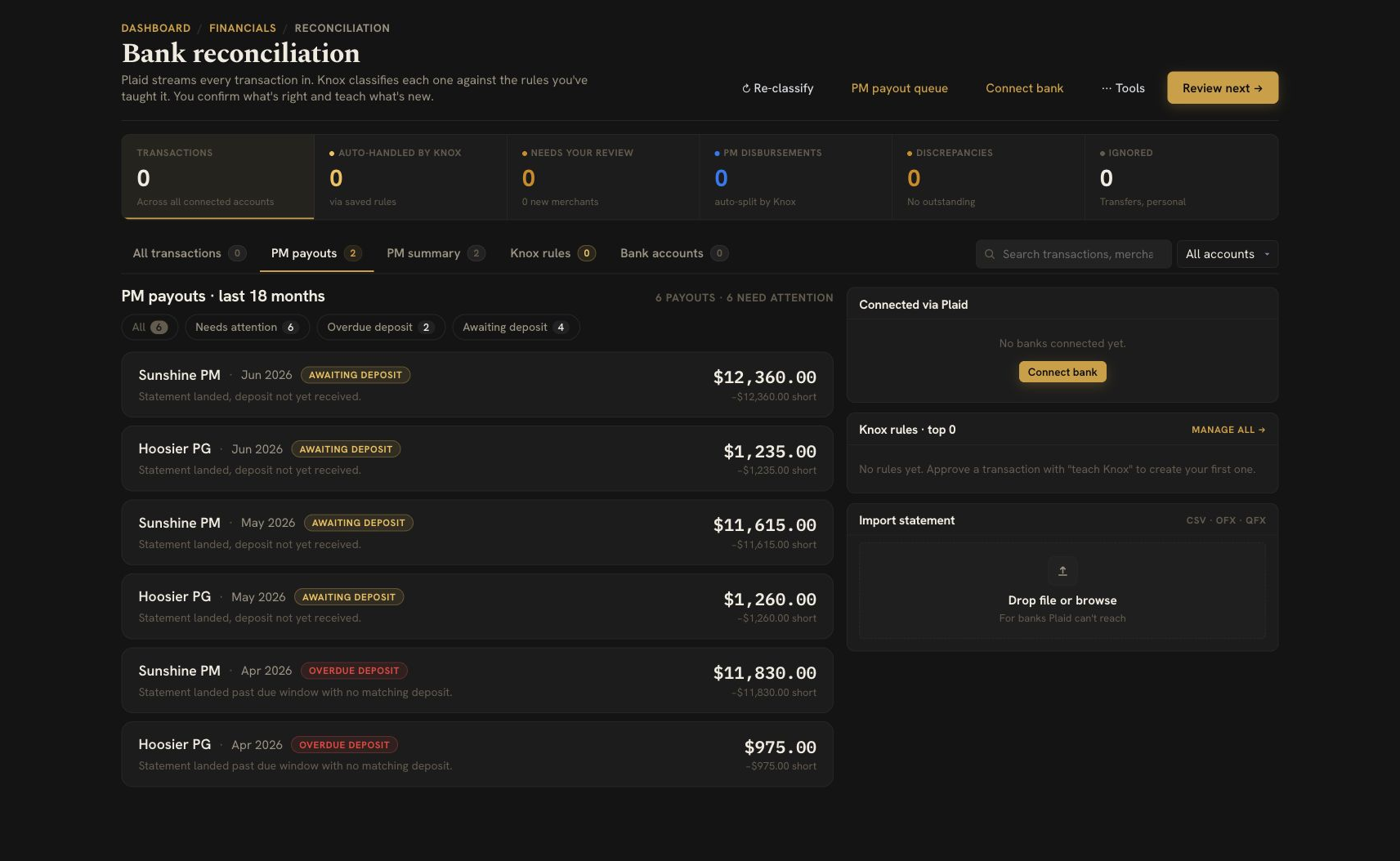
DoorVault’s PM payout queue is built around that check. The owner statement, bank feed, property, and deposit status stay connected, so a missing payout does not vanish into next month’s spreadsheet.
Maintenance cost needs a denominator
“Maintenance was high this month” is not a metric.
High against what?
Track maintenance cost per property, per occupied unit, and as a percent of collected rent. A $700 repair across one $1,200 unit hurts differently than a $700 repair across a 6 door cluster collecting $7,800.
Also track repeat categories. One plumbing bill can be normal. Four plumbing bills in 90 days is a pattern. Same vendor, same unit, same issue, same month. That is not bookkeeping. That is asset management.
The useful owner question is not whether the PM paid the vendor.
It is whether the repair pattern changed your decision about the property, the tenant, the vendor, or the manager.
DoorVault keeps invoices, statements, transactions, documents, and property performance tied together. The repair line can stay connected to the invoice, the property, the month, and the tax category instead of becoming one vague expense total.
Vacancy days beat vacancy stories
Every PM can explain a vacancy after it happens.
The number you need is days vacant. Then days listed. Then days from application to move in.
Vacancy is where soft reporting gets expensive. A unit empty for 18 days might be fine if the rent increased and the tenant quality improved. A unit empty for 52 days because the make ready drifted is a different conversation.
Track 3 numbers:
- Days from notice to market ready.
- Days from market ready to approved application.
- Days from approval to move in.
Those are owner-side metrics because they separate price, process, and execution. Without that split, the explanation usually sounds reasonable and still costs you a month of rent.
Fees only matter against the agreement
A PM fee is not good or bad by itself.
It is good or bad against the contract, the rent collected, and the work performed.
Track management fee percent on collected rent, leasing fees, renewal fees, maintenance markup, inspection fees, admin fees, and reserve movements. The issue is not that fees exist. The issue is fee drift.
Fee drift shows up when the agreement says one thing and the statement quietly teaches you a different pattern.
That is why the metric should be contract variance, not “total fees.” If the agreement allows 8 percent of collected rent and the statement calculates 8 percent correctly, fine. If a vacancy fee appears, a renewal fee repeats, or a maintenance markup changes the repair economics, the owner should see it immediately.
DoorVault’s PM Report Card gives that comparison a home.
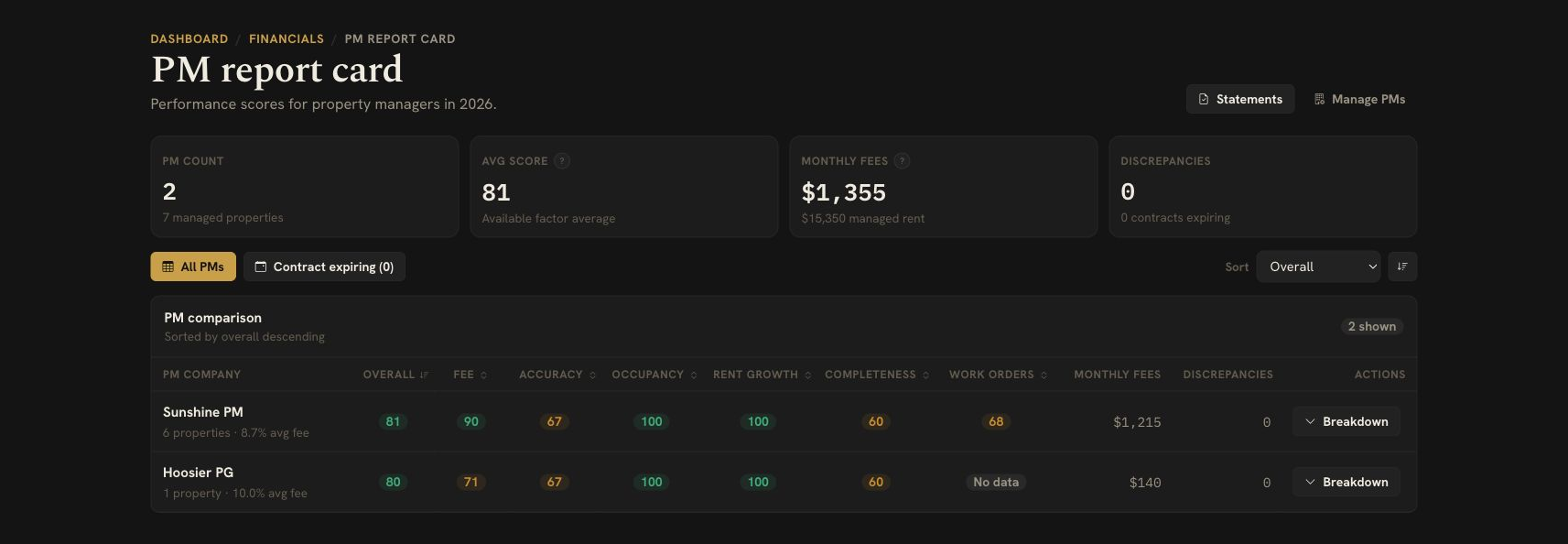
The score is not a popularity contest. It is a way to compare fees, accuracy, occupancy, rent growth, completeness, work order visibility, monthly fees, and discrepancies across managers.
A good report card connects the whole asset
Here are the 7 property manager performance metrics worth tracking every month.
- Statement timeliness.
- Net payout variance.
- Rent collected versus rent expected.
- Maintenance cost per property and percent of collected rent.
- Repeat repair pattern by category and vendor.
- Vacancy days by stage.
- Fee variance against the management agreement.
You can add more later. Start there.
Those 7 numbers are enough to change the owner conversation from “I think the PM is doing fine” to “I know where the asset is drifting.”
DoorVault was built for that owner-side view. Knox can read PM statements, extract rent, repairs, PM fees, reserves, and make ready lines, then put them in review before they touch the books. DoorVault Connect can help owners bring in PM portal data from supported systems without handing over PM credentials. The Action Center flags missing deposits, statement discrepancies, fee variance, repeated repair charges, and manager score trends before the problem becomes tax season homework.
The same record carries the rest of the asset too: documents, bank transactions, entities, loan context, equity, NOI, Schedule E categories, and portfolio performance. That matters because the PM is only one layer of the asset.
The owner still needs the whole picture.
The test is whether you can act
A metric that does not change a decision is just reporting furniture.
Use these numbers to decide when to ask for backup, when to challenge a fee, when to inspect a repair pattern, when to push vacancy execution, when to renegotiate, and when to replace the PM.
That does not make you a micromanager.
It makes you the asset manager.
Your property manager can run the day to day work. You still need an owner system that proves the month happened the way the statement says it happened.
DoorVault already oversees $22M+ in rental real estate, tracks 280+ doors, and has reconciled 40,000+ transactions. The point is not more dashboards.
The point is knowing which number deserves your next question.
Free for 30 days. Everything unlocked. No credit card. https://doorvault.app