
The Property Manager Statement Checklist for Owners Managing Blind
A property manager statement is not proof.
It is the first witness. This property manager statement checklist is the monthly control that tells you whether rent collected, fees, reserves, invoices, payouts, and bank deposits all describe the same reality.
If they do not, you are managing blind.
That is the quiet problem with PM managed portfolios. The statement looks official. The totals are formatted. The owner draw has a neat number. Everyone feels briefly adult.
Then April arrives, the CPA asks for support, and the statement starts sweating.
The statement is only the first witness
Most owner statements answer one question: what did the manager say happened this month?
That is useful.
It is also incomplete.
A manager can report rent collected before the payout clears. A repair can appear without invoice detail. A reserve adjustment can look harmless until it repeats for 4 months. A management fee can be calculated on scheduled rent instead of collected rent. A tenant credit can sit on the ledger without reaching the owner view.
None of that requires fraud. Ordinary admin drift is enough.
That is why a monthly owner review needs more than a PDF. A recent owner statement reconciliation checklist frames the close process around raw data, reconciliation, and payout confirmation. A monthly report checklist points owners toward rent, collections, maintenance, vendors, and leasing context. Even a current investor discussion about screening managers keeps circling the same owner demand: show me the invoices, rent roll, and monthly statement.
Translation: do not read the statement like a receipt. Read it like testimony.
Six records make the month real
The owner packet for each property should have 6 records before the month closes:
- Rent roll or tenant ledger
- PM owner statement
- Invoice detail for every repair and bill
- Reserve balance activity
- Distribution schedule or owner payout calculation
- Bank deposit match
That is the checklist.
Yeah, that’s it.
If rent collected is $4,200, repairs are $615, PM fees are $374, reserves moved by $250, and the owner draw says $2,961, the bank deposit should not require interpretive dance. It should match, or the gap should have a label.
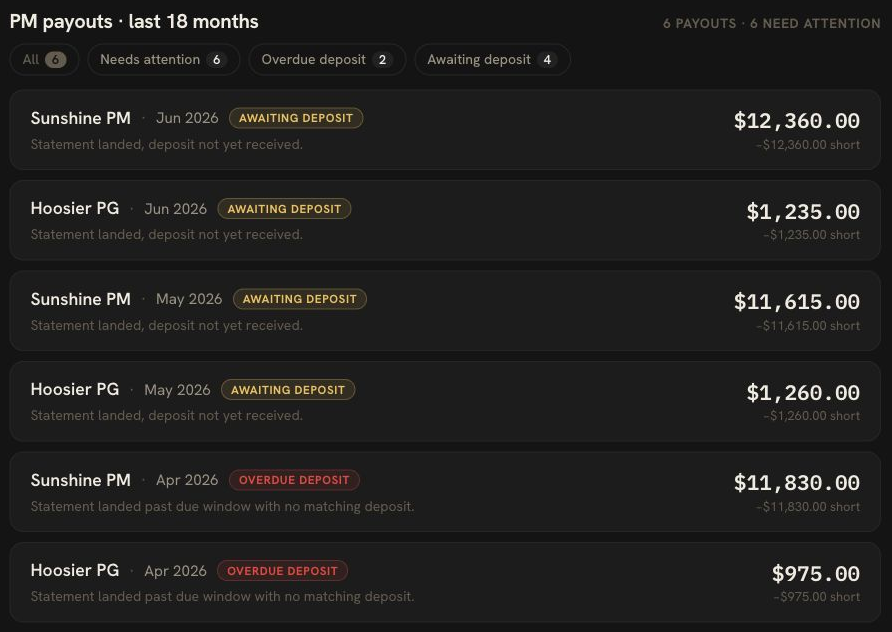
Awaiting deposit.
Partial payout.
Reserve holdback.
Invoice missing.
Fee review needed.
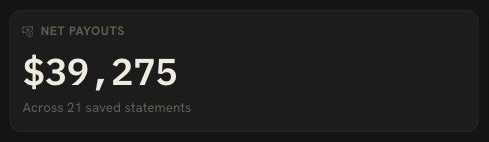
DoorVault keeps saved PM statements visible by property and period, including net payouts, fee patterns, review status, and discrepancies. The point is not to stare harder at statements. The point is to turn statements into a queue of things that are clean, missing, or suspicious enough to review.
For the deeper reconciliation workflow, keep this guide nearby: https://blog.doorvault.app/how-to-reconcile-an-owner-statement-when-you-use-a-property-manager
The fee question is collected rent, not scheduled rent
The fastest red flag is usually the fee basis.
If your PM agreement says 8 percent of collected rent, the fee should follow collected rent. Not scheduled rent. Not “rent due.” Not a heroic version of the month where every tenant paid on time because the spreadsheet felt optimistic.
Say scheduled rent is $5,000 and collected rent is $4,600. An 8 percent fee on collected rent is $368. An 8 percent fee on scheduled rent is $400. That $32 gap is not a lawsuit. It is a question.
Now multiply that by 12 months, 6 doors, and a few repair markups that nobody documented.
That is how owners lose money quietly.
The review should also look for repair approval thresholds, vendor markup, duplicate charges, utility reimbursements, late fees, security deposit movements, reserve holds, leasing fees, inspection fees, and anything described as “misc.”
“Misc” is not a category.
It is a hiding place with a better outfit.
If the statement does not show the basis, ask for the supporting ledger. If the ledger does not explain it, ask for invoice detail. If invoice detail is unavailable, do not close the month as clean.
DoorVault turns the checklist into a review queue
DoorVault is built for owners who use property managers but still want control of the asset record.
Forward the PM statement. Upload invoices. Sync a folder. Connect the bank. DoorVault reads the statement, keeps the source file attached, checks payout history, ties activity back to the property, and flags records that need owner review.
That matters because PM oversight is not one feature. It touches the whole owner system.
Knox reads the statement and supporting documents. The document library keeps proof attached to the right property. Payout reconciliation checks whether the statement agrees with the bank. The Action Center keeps open questions from disappearing. Reports keep the tax record clean. The PM Report Card shows whether the same manager keeps creating the same exceptions.
You do not need a bigger spreadsheet.
You need the statement, ledger, invoice, reserve, payout, and bank record to stop pretending they live in separate universes.
Use the PM performance view with this related guide: https://blog.doorvault.app/property-manager-performance-metrics-owner-report-card
The monthly owner question
At the end of every month, ask one question:
Could I explain this statement to my CPA, lender, or future buyer without asking the property manager to reconstruct the month?
If the answer is yes, close it.
If the answer is no, the month is still open.
The right checklist does not make you paranoid. It makes you precise. It keeps the manager relationship cleaner because the questions are about records, not vibes.
Show me the ledger.
Show me the invoice.
Show me the reserve movement.
Show me the payout date.
Show me the bank match.
That is not micromanagement. That is asset management.
FAQ
What should I check on a property manager statement?
Check collected rent, management fees, repairs, reserves, owner payout, and the bank deposit. Each number should tie to a ledger, invoice, reserve record, payout schedule, or deposit match.
How do I know if a property manager fee is charged correctly?
Start with the fee basis in the agreement. If the agreement says collected rent, calculate the fee on collected rent, not scheduled rent. Any difference should be labeled and explained.
Should the owner statement match the bank deposit?
Yes, or the difference should have a clear reason. A statement can arrive before the deposit clears, but the owner record should show awaiting deposit, partial payout, reserve holdback, or another specific cause.
What should I ask my PM for if the statement is unclear?
Ask for the tenant ledger, invoice copies, reserve activity, fee calculation, and exact payout date. If the manager cannot provide those records, do not treat the month as clean.
If your PM statement is still a PDF you trust on vibes, start with DoorVault at https://doorvault.app.
Forward the statement. Knox does the boring part. You review the exceptions.