
The PM Billed Me Twice for a Leak That Was Never Fixed
The leak was not fixed.
The charge still showed up twice.
That is the part of property manager oversight nobody wants to talk about. A property manager charged twice for repair work, the statement looked official, and the owner only caught it because they read the boring row instead of filing the PDF.
The direct answer
If a property manager charged twice for a repair, do not start with a fight. Start with four records: the PM statement, the invoice, the work order history, and the bank deposit.
If those four records agree, you have a repair cost.
If they do not, you have a question.
That sounds small until the charge is $300 and the property only cash flows $250 in a normal month. One duplicate plumbing charge can erase the month. Two of them can make a decent asset look broken when the asset is fine and the owner side records are not.
This is why the owner statement is not enough. An owner statement is supposed to show income, expenses, reserves, and net payout. Good. But even owner statement explainers tell owners to cross check statements against bank records and look for duplicate entries. That is the job. The PDF is the starting point, not the verdict.
For the full monthly version, use the owner statement reconciliation guide. This article is the sharper repair charge version.
A repair line is not proof
The sentence “plumbing repair, $300” is not documentation.
It is a label.
A real repair trail has at least four pieces:
- The tenant or inspection issue that started it.
- The work order opened by the PM.
- The invoice or receipt from the vendor.
- The closeout note that says what was fixed.
If the same leak appears again next month, the question is not “why is maintenance high?”
The question is sharper:
Was this the same issue, a second issue, or the same invoice billed again?
Those are three different answers. They lead to three different decisions. A second issue may be real. The same issue may mean the first repair failed. The same invoice billed again is a mistake.
Treating all three as “maintenance” is how owners lose money politely.

The $300 email to send your PM
Do not send a vague note.
“Can you explain this charge?” is how you get a vague answer.
Send the row, the month, the amount, and the proof you expect back:
Statement shows a $300 plumbing repair for the recurring leak in May. April also included a plumbing repair for the same issue. Please send the May invoice, the April invoice, and the work order closeout notes so I can confirm whether this is a new repair, a failed prior repair, or a duplicate charge.
That is the whole email.
One row. One issue. Three possible explanations.
No drama. No audit speech. No ten paragraph complaint about trust.
The PM can now answer the actual thing. If they send the invoice and the work order shows a new failure, fine. If the work order was never closed, you have a performance issue. If they cannot produce the invoice, the charge does not get treated as clean.
State repair rules vary, and tenant chargeback rules are a different lane. California’s tenant repair guidance, for example, is built around notice, reasonable time, receipts, and documentation. Different context, same boring lesson: repair costs need a paper trail.
The bank deposit is the final check
The statement can still balance while the cash tells a different story.
Say the statement shows:
- Rent collected: $1,450.
- PM fee: $145.
- Plumbing repair: $300.
- Reserve top up: $100.
- Owner payout: $905.
Now check the bank.
If the bank deposit is $905, the statement and deposit agree. You still have to verify the $300.
If the bank deposit is $855, there is a $50 gap that needs a label.
If the statement shows the same $300 repair in April and May, the property did not suddenly become worse. The records became suspect.
This is where a lot of owners stop too early. They read the PM statement and assume the bank deposit is the same story in cash form.
Sometimes it is.
Sometimes a reserve movement, correction, owner contribution, or missing line item is hiding between the two.
That is why the broader PM statement verification loop matters. The duplicate repair is one row. The monthly close is the system that catches it.
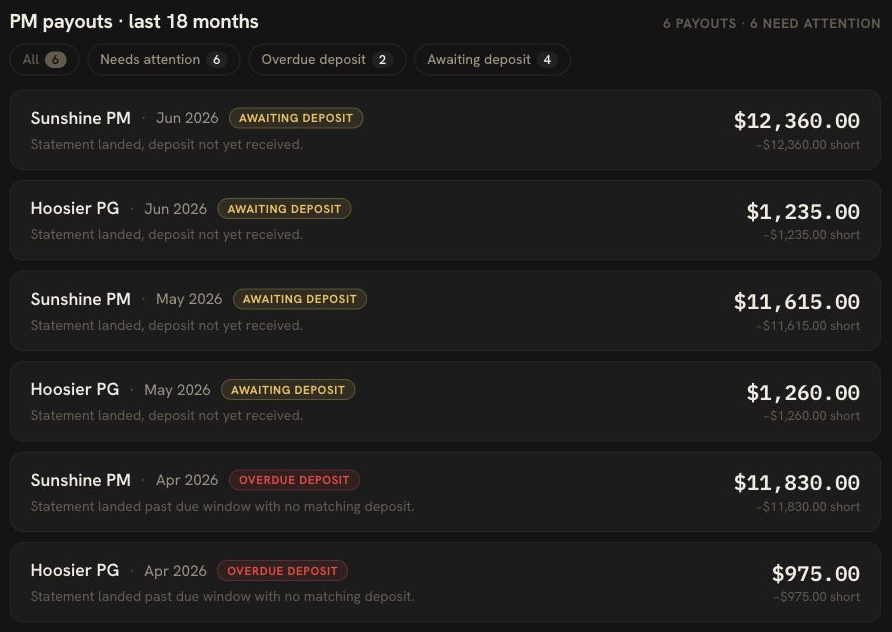
How DoorVault turns this into exception review
DoorVault is built for investors who use property managers and still need to run the asset side.
The product version of this is property management statement reconciliation, built for the owner who needs the catch without living inside the PM’s portal.
Forward any property related email to your Knox inbox. PM statements, repair invoices, insurance renewals, tax bills, closing docs, lease packets, inspection reports. Knox reads the attachments, files them to the right property, and proposes the transactions.
For a duplicate repair charge, Knox does the boring catch:
- Reads the PM statement line by line.
- Creates the rent, fee, reserve, and maintenance transactions for review.
- Links invoices and receipts to the property record.
- Matches the PM payout against the bank deposit.
- Flags duplicate charges, unusual expenses, missing rent, and payout gaps.
- Rolls the clean numbers into per property P&L, portfolio cash flow, PM Report Card, Schedule E export, loan context, equity, and entity reporting.
Knox Intelligence is reviewable by design. Leave Trust Knox off and every proposed change waits for approval. Turn it on and routine changes move faster. Either way, the Activity Log keeps the before and after record.
That is the point.
The PM runs the property. DoorVault verifies the asset.
You still make the call. You stop hunting for the row.
The 10 minute monthly rule
Do this once a month.
Pick the largest maintenance charge. Match the statement row to the invoice, the work order, and the bank deposit.
Then pick any repeated vendor or repeated issue. Same match.
If the records line up, move on. If they do not, send the $300 email.
This is not about becoming difficult. Good PMs should welcome clean questions. Clean questions protect them too, because they stop every repair discussion from turning into a foggy argument 4 months later.
The bad version of oversight is reading every line forever.
The good version is building a system where the duplicates surface by themselves.
That is what owners actually need. Not another portal. Not another PDF. A clean catch.
FAQ
What should I do if my property manager charged twice for the same repair?
Ask for the statement line, invoice, work order notes, and closeout record for both charges. Then match the final owner payout to the bank deposit. If the PM cannot show why the second charge is distinct, do not treat the month as clean.
Are property managers responsible for repair costs?
Usually the owner pays for normal property repairs, while tenant caused damage depends on the lease, state law, and documentation. The property manager normally coordinates the repair. The owner still needs the invoice trail.
How do I tell if a repair charge is duplicate?
Look for the same vendor, same issue, same property, same amount, or same work order appearing across two statements. Then ask whether the second row is a new repair, a failed prior repair, or the same invoice entered twice.
Can DoorVault catch duplicate PM charges?
Yes. DoorVault reads PM statements, files invoices, matches payouts against bank deposits, and flags duplicate charges or unusual maintenance patterns for review. It is built for owners who use PMs and want the catch without doing the whole month by hand.
Still checking PM repair charges in a PDF? Go to https://doorvault.app and let Knox do the boring part.