
Your Section 8 HAP Payment Is Late. Now What?
A late HAP payment is not a vibes problem.
It is a proof problem.
Section 8 owners already know the rent arrives in pieces. The housing authority pays the HAP portion. The tenant pays the tenant portion. Your property manager may collect both, report one net owner payout, and send a statement that makes the whole thing look calmer than it felt in real life.
Then the payment date moves.
In July 2026, Monroe County Housing Authority told Section 8 owners that beginning in August, HAP payments would arrive on the second business day instead of the first because of banking rule changes. In June 2026, the Housing Commission of Anne Arundel County reported a one day HAP processing delay after HUD and Treasury deposit timing issues. In December 2025, Boston Housing Authority released 25 percent of December payments while waiting on full federal funding.
That range matters.
One day late is annoying. A partial payment is operational. A missing deposit with no explanation is when owners start staring at the bank account like it owes them an apology.
First, separate late from missing
The first question is not, “Where is my rent?”
The first question is, “Which part is late?”
A Section 8 month has at least 6 numbers the owner should know: contract rent, expected HAP, tenant portion, expected payment date, actual deposit, and the PM statement payout.
If contract rent is $950, HAP is $820, and the tenant portion is $130, a missing $130 is not the same problem as a delayed $820. A one day housing authority date change is not the same as an inspection abatement. A PM statement that says “collected” is not the same as a bank deposit.
This is where owners lose control. The money looks like one monthly rent line, but the proof lives in several places.
Your HAP contract says what the authority is supposed to pay. The voucher record shows the split. The inspection record can explain a stoppage. The bank proves cash actually arrived. The PM statement proves what your manager says happened.
If you only check one of those, you are not tracking rent. You are checking vibes with a calculator.
For the base HAP tracking system, keep this guide next to the article: https://blog.doorvault.app/hap-payment-tracking-never-miss-a-section-8-payment-again
Build the 6 number owner view
The owner view should be boring.
That is the goal.
For every voucher unit, keep a monthly record with these fields: property, housing authority, contract rent, HAP portion, tenant portion, expected HAP date, expected tenant date, actual bank deposit, PM statement month, and status.
The status should be plain English.
Paid. One day late. Tenant portion missing. Awaiting PM statement. Inspection issue. Authority notice received. Needs owner review.
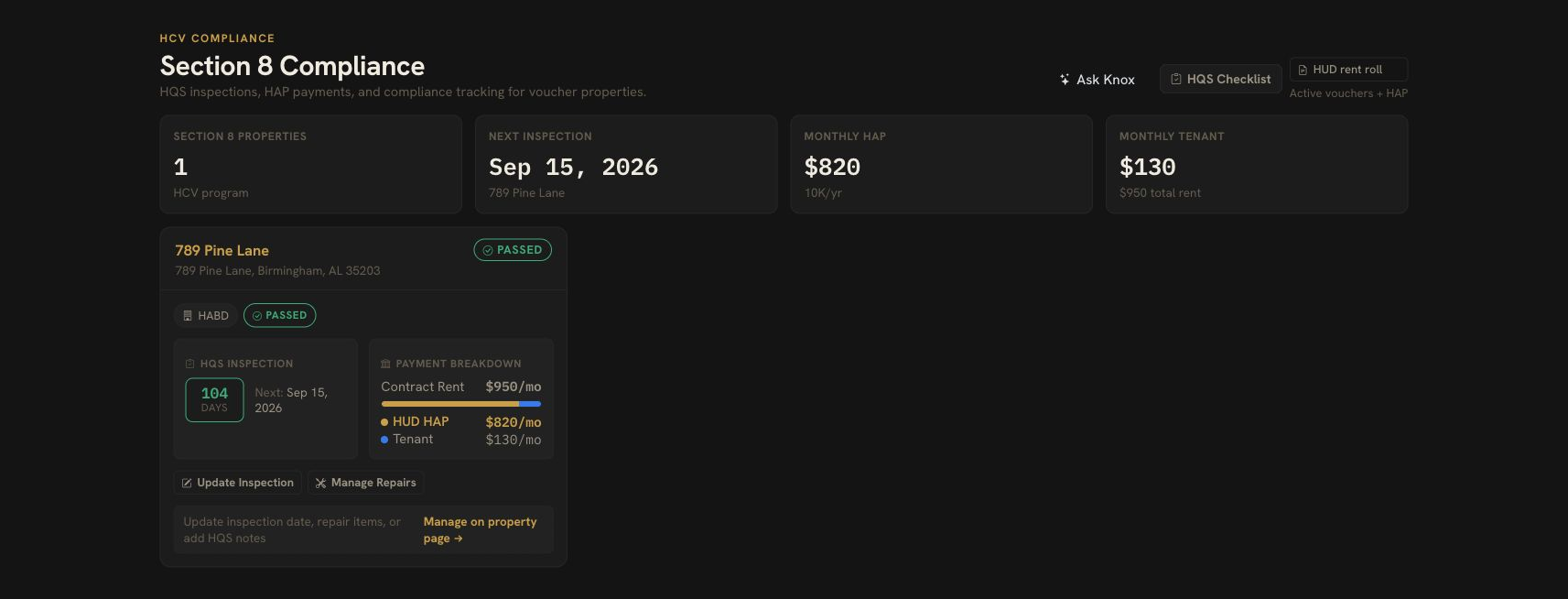
DoorVault keeps Section 8 compliance visible by property, including HAP amounts, tenant portions, inspection timing, and voucher context. That matters because HAP delay research is useless if the owner cannot see which unit is affected.
The shape is simple. The discipline is not.
Most owners can remember that a payment was late this month. They cannot remember 7 months later whether the delay was a housing authority notice, a failed inspection, a manager holdback, or a tenant portion issue. That memory gets even fuzzier when the PM payout bundles several homes into one deposit.
One unit is manageable. Four voucher units across two managers is a filing cabinet wearing a fake mustache.
The PM statement can hide the real delay
If you use a property manager, the HAP delay may not show up as “late HAP” on your statement.
It may show up as a lower owner draw.
It may show up as an “awaiting deposit” note.
It may show up as nothing at all until you ask.
That is why HAP tracking and PM reconciliation belong together. A housing authority can pay late. A tenant can miss their portion. A manager can hold reserves. A statement can land before the bank deposit arrives. Each one needs a different follow up.
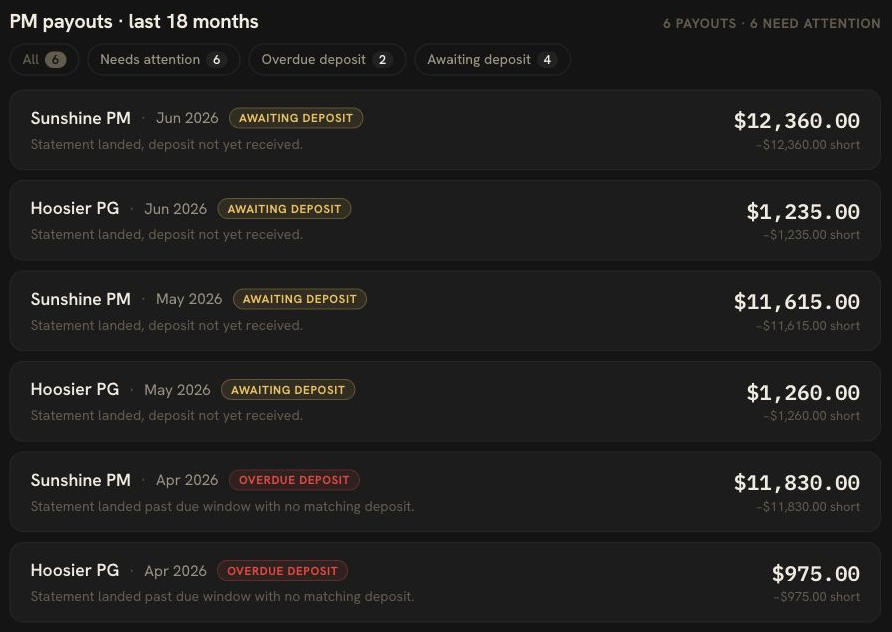
DoorVault PM payout reconciliation checks whether statement payouts are supported by bank deposits. If the statement landed and the deposit did not, the owner can see that gap instead of discovering it after the mortgage draft clears.
This is not about mistrusting your manager.
It is about using the right record for the right question.
Ask the housing authority about the HAP date. Ask the tenant or manager about the tenant portion. Ask the manager about statement timing. Ask the bank record whether cash arrived. Do not ask one system to answer all four.
Watch the inspection and voucher dates
Not every HAP issue starts in the payment file.
Some start in the compliance calendar.
An overdue inspection, failed inspection, reinspection delay, expired voucher action, rent increase review, or missing paperwork can change payment timing. The owner may hear “HAP is late” when the real issue is that the unit is stuck in a compliance step.
That is a different playbook.
If an inspection failed, the owner needs the repair list, photos, work order status, reinspection date, and payment impact. If the voucher record changed, the owner needs the updated HAP portion and tenant portion. If the authority changed the payment schedule, the owner needs the notice saved with the property record.
For deeper inspection handling, use the related guide here: https://blog.doorvault.app/section-8-failed-inspection-the-landlord-playbook
The operational rule is simple. Never let a HAP delay float without a cause label.
Late because of bank processing.
Late because of authority funding timing.
Late because inspection is open.
Late because tenant portion is missing.
Late because the PM statement and bank deposit do not agree.
Once the label is clear, the next action usually becomes obvious.
DoorVault turns the chase into a monthly control
DoorVault is built for investors who use property managers and still need an owner side system of record.
Forward the authority notice. Upload the HAP contract. Save the PM statement. Connect the bank feed. DoorVault keeps the Section 8 record, PM statement, documents, Action Center item, and payout reconciliation tied to the same property.
Knox reads statements, flags uncertain items for review, and keeps owner questions from disappearing into email. DoorVault Connect helps owners bring supported PM portal data into the owner view. Bank reconciliation checks whether the cash showed up. The Section 8 compliance view keeps HAP, tenant portion, inspections, and voucher records close enough to act on.
That is the difference between “I think the authority is late” and “789 Pine Lane has an $820 HAP expected, a $130 tenant portion, a September 15 inspection date, a statement awaiting deposit, and a manager follow up open.”
The second version is not dramatic.
It is useful.
The owner still cannot force a housing authority to move faster. DoorVault does not pretend otherwise. What the owner can do is prove the amount, source, timing, and next step without rebuilding the month from PDFs and bank lines.
Use this monthly HAP delay checklist
Run this check for every Section 8 unit before you close the month.
First, confirm contract rent, HAP portion, and tenant portion. Second, confirm expected HAP date against the housing authority notice or portal. Third, verify tenant portion status. Fourth, compare the PM statement payout to the bank deposit. Fifth, check inspection and voucher dates. Sixth, save any authority notice or manager explanation with the property.
That is the whole system.
Not fancy. Not loud. Not the kind of thing anyone brags about at dinner unless the dinner has already gone badly.
But it protects the owner from the expensive version of confusion.
When HAP moves by one day, you know it. When the tenant portion is missing, you know it. When the PM statement says paid but the bank says not yet, you know it. When the inspection clock is the real problem, you know it before the next statement arrives.
For the broader voucher tracking setup, read this next: https://blog.doorvault.app/section-8-voucher-tracking-what-every-landlord-needs-to-know
Your manager can run the property. The housing authority can run the voucher. DoorVault gives you the owner record that proves what happened.
Free for 30 days. All features included. No credit card. https://doorvault.app