
What Is a Section 8 HAP Contract? The Landlord Guide to Payments, Inspections, and Compliance
If you are asking what is a HAP contract, you are usually not asking a legal question. You are asking an operational question: who owes what, when the money hits, what happens when an inspection fails, and why a “guaranteed rent” unit can still surprise you.
If you use a property manager, this gets worse. Your PM is the one emailing the PHA and scheduling the inspection. You are the one who eats the missed HAP month, the delayed paperwork, or the abatement.
Here is the plain English version, plus the tracking system that keeps it predictable.
What a Section 8 HAP contract is (and what it is not)
A Housing Assistance Payments (HAP) contract is the agreement between the Public Housing Agency (PHA) and the property owner that governs the housing authority portion of rent for a Housing Choice Voucher (Section 8) unit.
It is not your lease with the tenant. It is the document that ties together:
- The unit and the approved rent
- The payment split between the PHA portion and the tenant portion
- The rules that keep payments active, including Housing Quality Standards (HQS) inspections
- What happens when requirements are not met, like payment abatement and contract termination
Most landlords file the HAP contract and move on. The HAP contract is the control document for your Section 8 unit. If your numbers drift, your inspection fails, or your paperwork is missing, your cash flow feels it first.
HAP contract vs lease vs tenancy addendum: who signs what
You are effectively running three parallel agreements:
- Lease (owner and tenant): This is your normal rental agreement. It governs rent due dates, late fees on the tenant portion, move in and move out rules, and the day to day tenancy.
- HAP contract (PHA and owner): This governs the subsidy portion, the program rules, and the inspection and compliance requirements that keep the PHA paying.
- Tenancy addendum (tenant and owner, HUD required): This is the Section 8 overlay that modifies the lease for voucher rules. It is why you cannot treat a voucher lease exactly like a market lease, even if your PM wants to.
Why does this matter? Because the fastest way to create chaos is to enforce the wrong agreement.
Example: the tenant paid their portion on time, but the PHA portion is late or paused. Sending the tenant a notice for money they do not owe is how good voucher placements die.
As an owner, make sure your PM keeps these lanes separate. Tenant portion issues are a lease problem. HAP portion issues are a HAP contract problem.
The minimum HAP contract tracking system (dates and numbers)
If you only track one thing, track this: every Section 8 unit has a small set of fields that must stay accurate over time, even as recertifications, rent changes, and inspections happen.
Here is the minimum you should be able to answer for every voucher unit:
- Contract rent (approved rent)
- Tenant portion (the tenant’s required share)
- HAP portion (PHA share)
- Effective date (when the current rent split starts)
- Next inspection date and inspection history
- Utility responsibility if applicable
- Your PHA contact and payment method (ACH, check)
Now the practical part: reconcile three numbers every month.
- What the HAP should be for that month (based on the current contract terms)
- What actually hit the bank
- What your PM statement claims was received and disbursed
If any of those three disagree, you have work to do that week, not next quarter.
A concrete example (with real world failure modes)
Assume a unit has an approved contract rent of $1,350.
The tenant portion is $420.
The expected HAP portion is $930.
If you receive $850 instead of $930, there are only a handful of reasons in practice:
- The tenant was recertified and their portion changed, but nobody updated the owner side records
- The rent increase was requested but not approved, so you are still being paid on the old split
- The unit failed HQS and payments were abated until repairs were verified
- The payment was short due to a processing hold, banking issue, or paperwork mismatch
You need a system that makes the mismatch obvious and a workflow that resolves it fast.
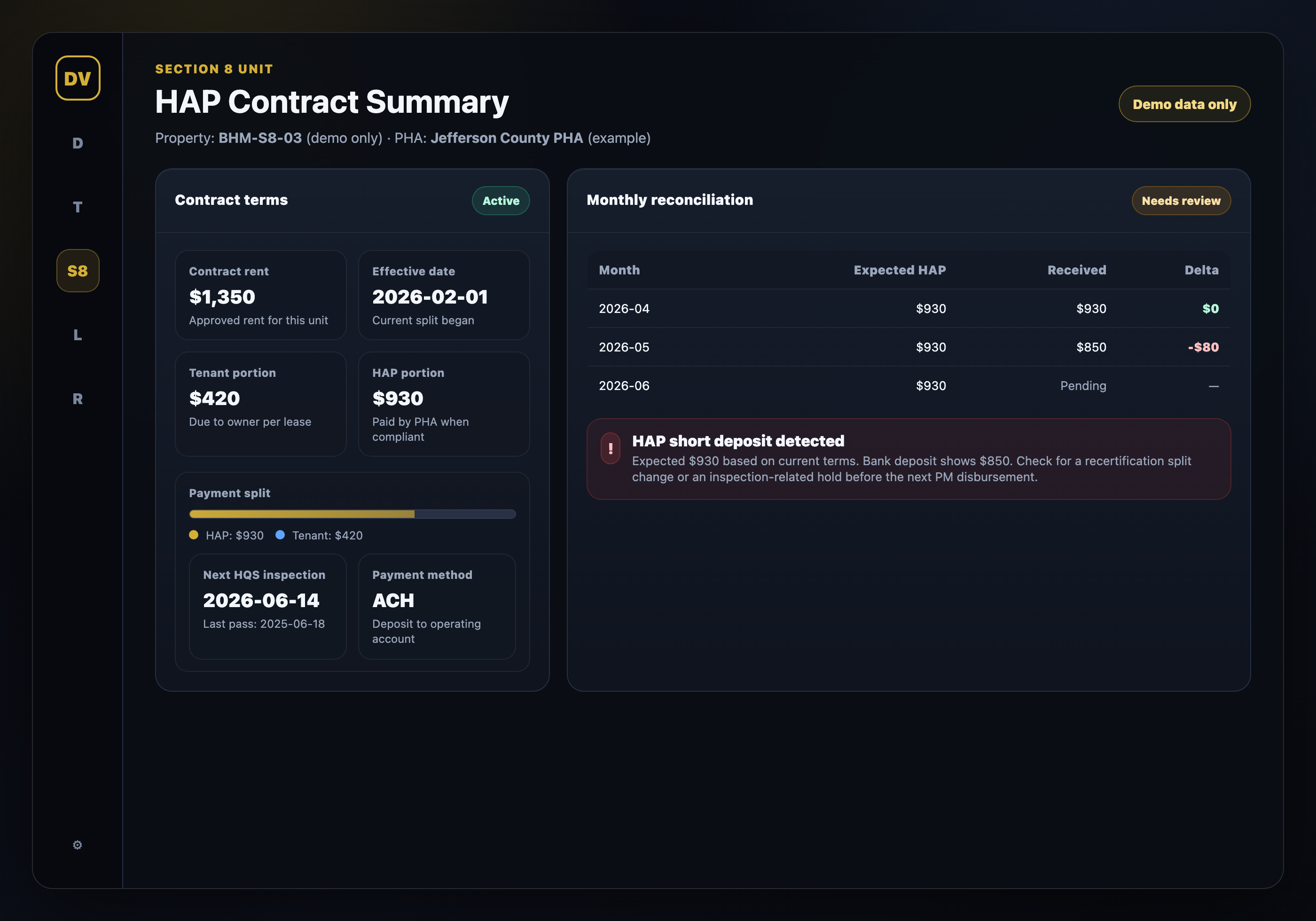
The five failure points that cause “missing” HAP payments
Most Section 8 payment problems are operational slippage. These are the failure points that hit landlords over and over:
- Initial contract lag: the tenant moves in, the lease is signed, but HAP execution and direct deposit setup lag behind. The first payment can be delayed, prorated, or arrive as a catch up deposit.
- Inspection failure and abatement: HQS failures are often small, but the financial impact is not small. Abatement means the PHA portion stops until the unit passes.
- Untracked recertification changes: tenant portion changes, HAP changes, or both. If you do not update the split, your “expected HAP” number is wrong, and reconciliation becomes noise.
- Rent increase window miss: many PHAs require notice well before the HAP contract anniversary. Miss the window and you wait another year. We break this down in detail here: https://blog.doorvault.app/section-8-rent-increase-annual-window
- Paperwork mismatch: name or entity mismatch on W 9, bank account changes not submitted, or owner transfer not processed. The PHA does not care that you “fixed it later.” They pay what matches their records.
When you own multiple voucher units, the worst part is not a single missed month. It is missing the pattern until it is expensive.
How DoorVault keeps HAP contracts, inspections, and payments tied to your portfolio
This is the exact reason DoorVault exists. Eduardo built it because even with property managers, the owner side work still ate 5 to 10 hours a month across 10 doors.
Knox Intelligence is the layer that turns paperwork into a living system. You forward a document, upload it, or sync a folder, and Knox proposes what to update. You can let Knox apply changes instantly, or you can keep control and approve everything first with the Trust Knox toggle.
For Section 8 specifically, this looks like:
- Upload the HAP contract, rent change notice, inspection report, or voucher doc
- Knox extracts the key terms and dates and files the document to the right property
- Knox creates or updates the structured Section 8 records so your expected split stays current
- If a payment looks off, Knox flags it as an anomaly so you do not find out months later
DoorVault does not stop at Section 8 tracking. Once your documents and transactions are structured, everything else gets easier:
- PM statement processing and owner statement reconciliation
- Bank sync and reconciliation so deposits match what your PM reports
- Portfolio dashboard and per property P and L so you see which units actually perform
- Loans dashboard and equity tracking so you understand debt and refinance timing
- Schedule E export and CPA portal so tax prep is not a fire drill
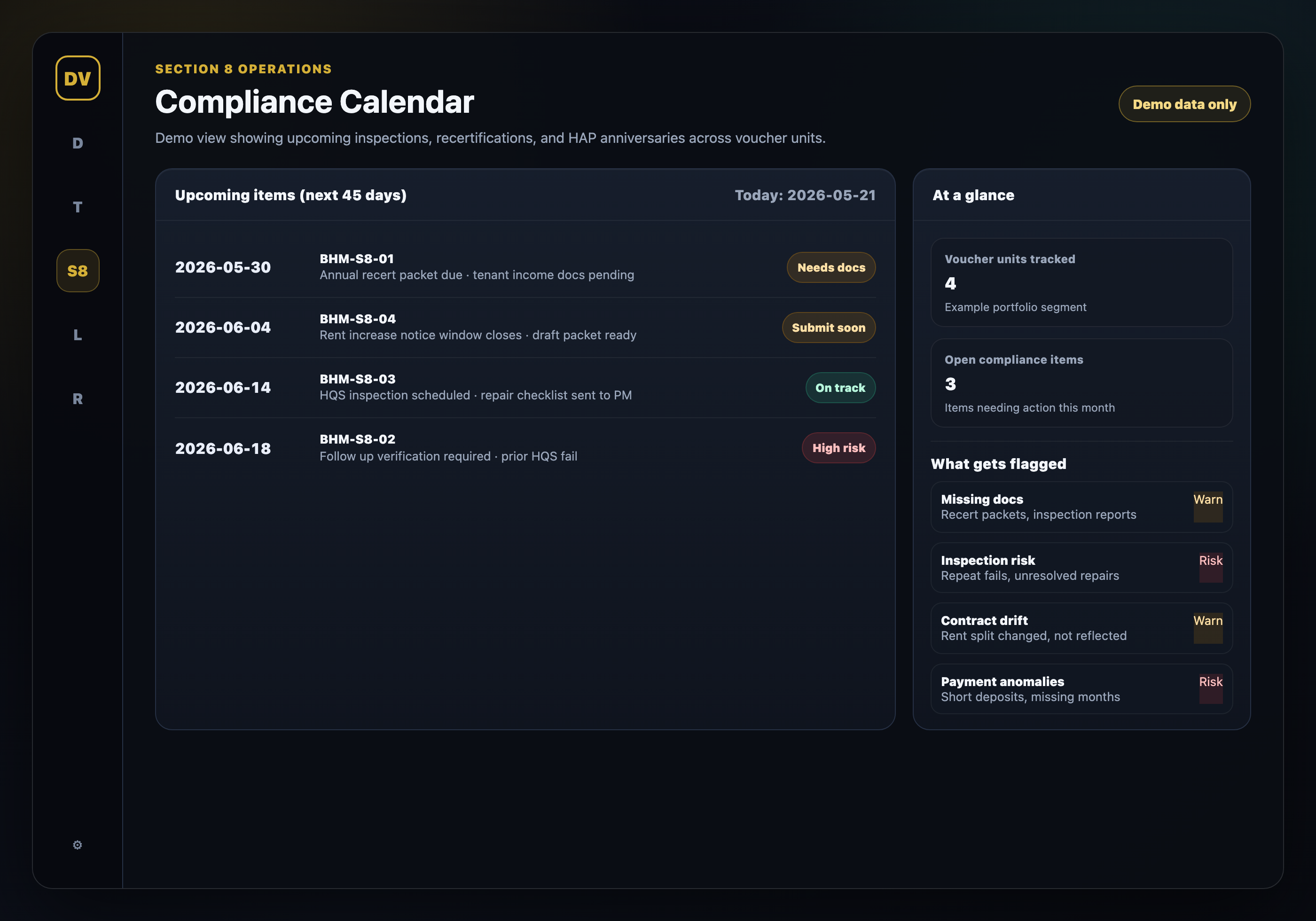
If you want the monthly reconciliation playbook for payments, read: https://blog.doorvault.app/hap-payment-tracking-never-miss-a-section-8-payment-again
If you want the annual cadence checklist, read: https://blog.doorvault.app/section-8-annual-recertification-landlord-checklist
FAQ: quick answers landlords actually need
Is a HAP contract a lease?
No. The lease is between you and the tenant. The HAP contract is between you and the PHA. They run alongside each other.
How long is a HAP contract?
In practice it tracks the lease term and continues as long as the tenant remains voucher eligible, the unit remains in compliance, and the subsidy remains active.
Does Section 8 mail checks or direct deposit?
It depends on the PHA. Many pay via ACH direct deposit, some still mail checks. The operational point is the same: reconcile expected vs received every month and investigate short deposits immediately.
What should I do if the HAP portion is short?
Treat it like a workflow, not a mystery. Confirm whether the tenant portion changed due to recertification, whether an inspection issue triggered abatement, and whether the PHA record needs an update. Document everything in writing, then follow up until the split is correct again.
The bottom line
The HAP contract is not a document you sign once. It is the operating agreement for your Section 8 cash flow. When you track the few fields that matter and reconcile monthly, Section 8 becomes predictable. When you do not, it becomes a surprise generator.
Try DoorVault free for up to 2 properties at https://doorvault.app. Knox handles the owner side paperwork, tracking, and reconciliation so you can focus on finding the next deal.