
Section 8 Failed Inspection: The Landlord Playbook
If your Section 8 unit fails inspection, the stressful part is not the failed outlet cover.
It is the timeline.
The notice shows up, your property manager is texting a contractor, and you are trying to figure out what the housing authority needs so the payments do not get stuck.
This is the landlord playbook for the next 30 days, written for investors who already use a property manager and still end up being the one who has to make the paperwork agree.
What a failed Section 8 inspection really means
A failed inspection is not a vibe check. It is an operational countdown.
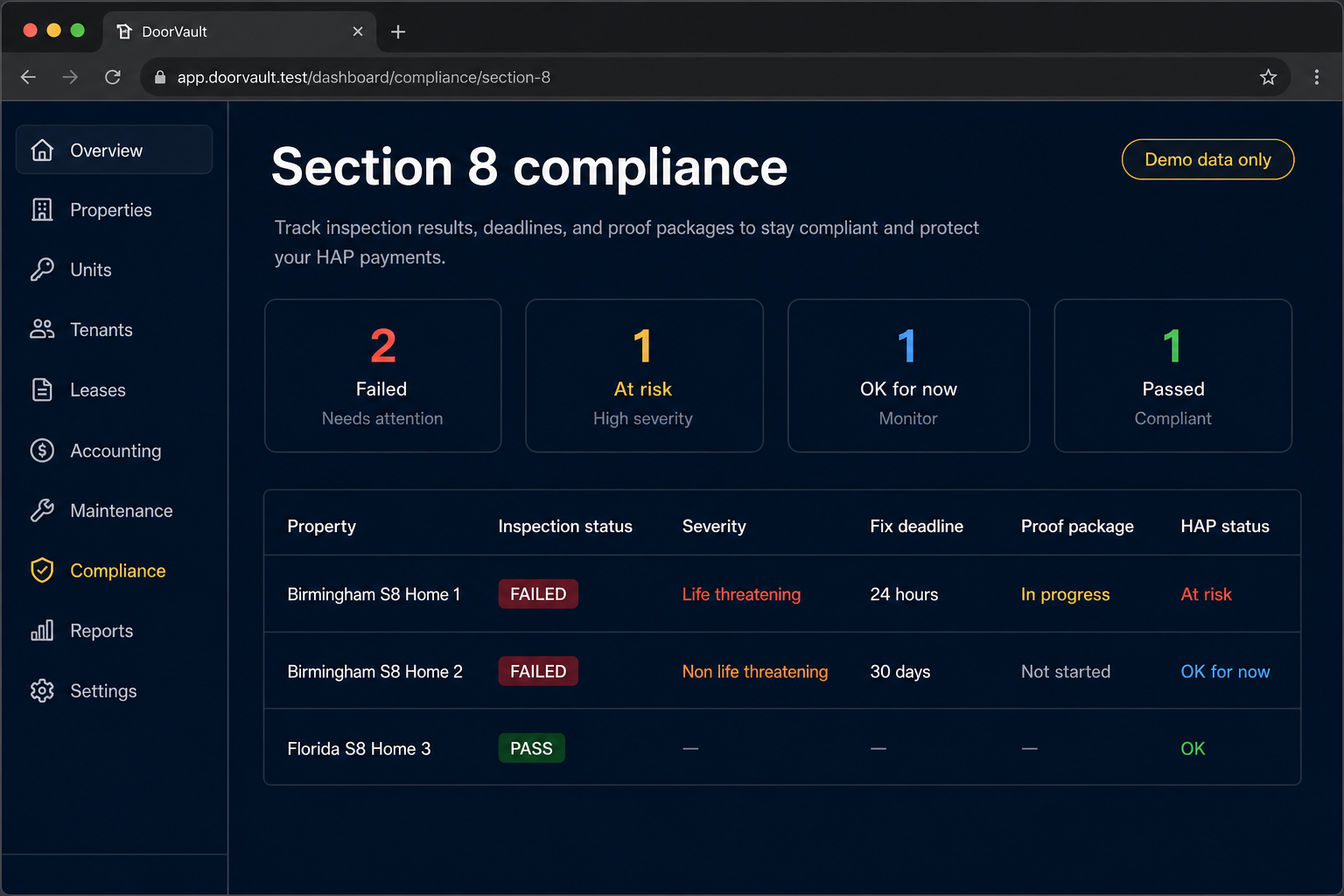
Most housing authorities split failed items into at least two buckets:
- Life threatening items
- Everything else
Those buckets drive everything that matters.
How fast you have to fix it. How fast they will re inspect it. Whether your HAP payment is withheld. Whether the unit goes into abatement. Whether the tenant is pushed to move.
You will see common deadlines like 24 hours for life threatening items and around 30 days for non life threatening items, but the exact rules vary by housing authority.
Either way, the landlord mistake is always the same.
They treat it like a normal maintenance ticket. It is not. It is a compliance event with a clock attached.
Here is the mental model that keeps you sane:
- The inspection notice is the source of truth
- The deadline is real, even if the contractor is not
- Proof is part of the work
If you do those three, you keep the process moving.
The first 24 hours: triage and ownership
In the first day, your job is to get clarity and set the workflow.
Here is the checklist.
- Get the full fail notice in writing
Do not rely on a phone call summary. Get the actual list of failed items and the deadline language. Save it to the property.
- Separate items by severity
Create two lists:
- Items with a 24 hour clock
- Items on the longer clock
The first list is the one that can create a fast payment problem. That is your priority.
- Decide who owns each fix
Every Section 8 program has some split between owner responsibility and tenant responsibility, especially when damage is clearly tenant caused.
You are not trying to argue. You are trying to assign the work correctly.
If you have tenant caused items, document them. Photos matter. The goal is to avoid paying twice on the same pattern next year.
- Confirm access and utilities
Confirm the unit has working utilities on. Confirm the tenant will allow entry. Confirm you have a point of contact who can open the door. If your contractor cannot get in, the clock does not care.
- Put re inspection on the calendar now
Even if you do not have the slot yet, set a target date and work backward.
If your deadline is 30 days, do not schedule the repairs on day 28 and hope for magic.
This is the part most investors miss when a property manager is in the middle. The PM can schedule repairs. You still own the timeline.
Build the proof package so re inspection is fast
Most failed inspections are fixable. The drag is the proof loop. The easiest way to stop it is to build the proof package as you go.
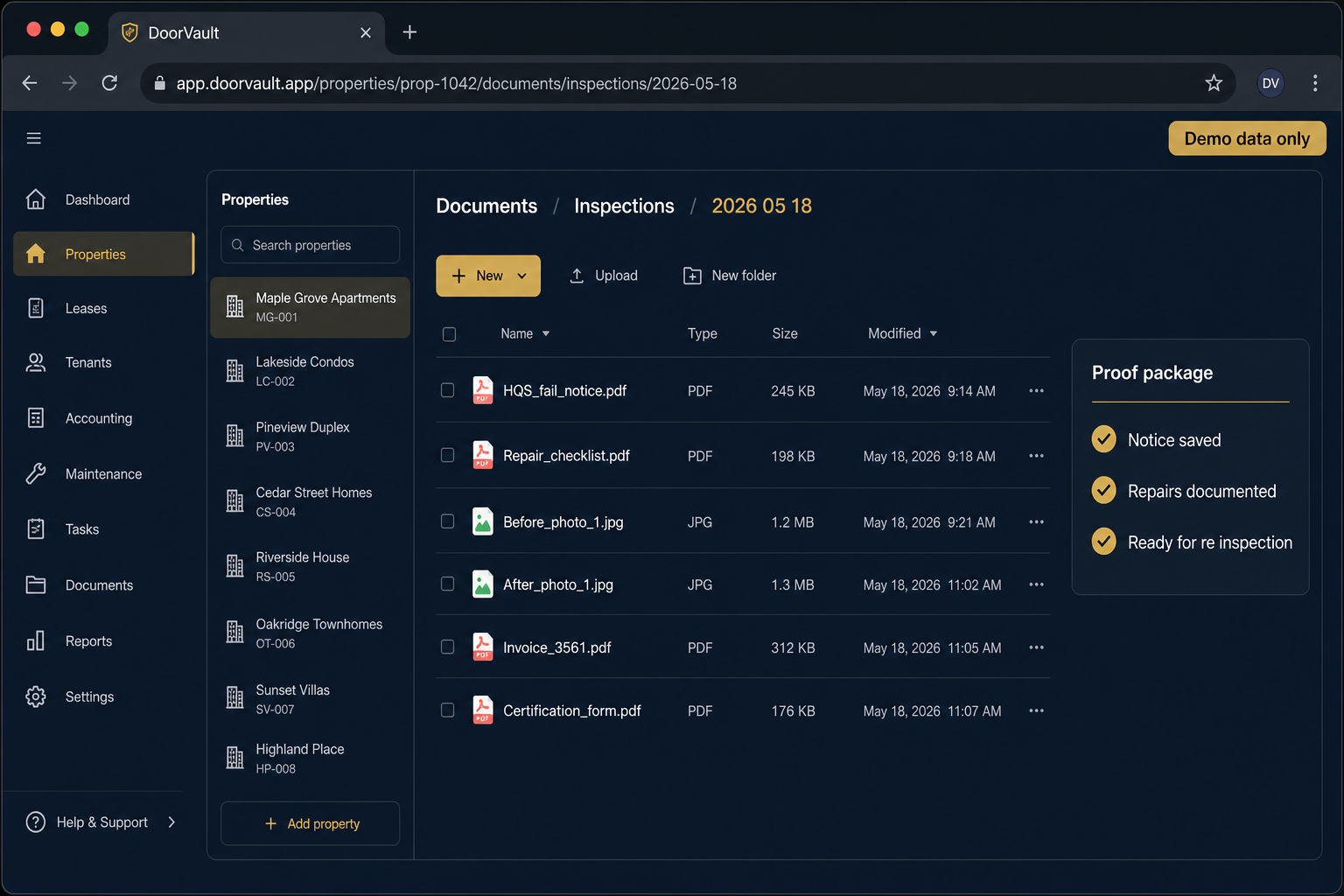
For each failed item, capture:
- Before photo
- After photo
- Invoice or receipt that matches the item
- Date the repair was completed
- Who did the work
If the housing authority requires a specific certification form, include that too.
This sounds like overkill until you have two Section 8 units fail in the same month and your inbox becomes a junk drawer.
Here is a clean way to store it that scales:
- One folder per property
- Inside it, one folder called Inspections
- Inside that, one folder per inspection date
- Inside that, the fail notice, photos, invoices, and any submitted forms
When you do this, you can answer the only question that matters in a re inspection scramble:
What changed, when, and where is the proof?
Prevent the next failure with a boring monthly routine
Most investors treat inspection prep like a once a year sprint.
That is why it always feels chaotic.
If you want Section 8 to stay boring, do a 15 minute monthly routine per property. Not a deep inspection. A quick pass that catches the common fail items before they become a deadline.
Here is a short routine that works even when a property manager handles the day to day.
- Ask your PM for a photo set once a month
Not a full photo shoot. Four photos:
- Smoke and carbon monoxide detectors
- Under sinks
- Electrical outlets in the kitchen and bath area
- Any visible trip hazards or broken windows
You are not trying to micromanage. You are trying to spot the repeat failure categories early.
- Track inspection dates like you track loan payments
The inspection is not a surprise. It is a calendar event.
If you have four Section 8 units across two states, you should be able to answer this question in 10 seconds:
Which properties have an inspection in the next 60 days?
- Watch the money for early warning
A failed inspection rarely comes out of nowhere. You usually see it in the statement first. Repeated plumbing. A spike in electrical. A new vendor every month. Track it per property so you catch drift before the inspector does.
Where DoorVault fits in this playbook
We built DoorVault for the investor side of owning rentals with property managers. This is one of those moments where you see why.
Knox Intelligence is AI that proposes, learns, and never touches your data without permission. You choose the speed versus control tradeoff.
In a failed inspection workflow, you need two things at the same time:
- A clean system that captures every document and transaction without you becoming the file clerk
- A review workflow you trust when the data affects payments and compliance
Here is what we use DoorVault for in this exact scenario:
- Forward the inspection email to your Knox inbox so the notice is filed to the right property
- Upload the contractor invoice so the expense is created and categorized to the right property and entity
- Keep inspection dates, voucher details, and HAP versus tenant portions tracked per property
- Use the Activity Log to see what changed and revert one field if something is mis filed
- Keep PM statements, bank deposits, and repair spend tied together so you can see the NOI impact in real time
And this is where the platform goes beyond inspections:
- Portfolio dashboard and per property P and L
- Loans dashboard with mortgage payment splitting and amortization visibility
- Bank reconciliation so deposits and disbursements match
- Multi entity reporting, Schedule E exports, and a CPA portal for tax season
Anyway, the point is not that an inspection is hard.
The point is that your PM portal will never be the owner system for this. You still have to own the proof, the deadlines, and the math. DoorVault is the layer that makes that owner side boring again.
FAQ
What happens to payments when a unit fails inspection
Many housing authorities will withhold or pause HAP payments when owner responsible items are not corrected by the deadline. Exact mechanics vary, so treat the notice as the source of truth and confirm with your housing authority.
How long do you have to fix failed items
You will often see 24 hour deadlines for life threatening items and longer deadlines around 30 days for non life threatening items. Some agencies use special timelines for specific categories. Verify your local rules.
Who pays if the tenant caused the damage
This depends on the housing authority and what they determine was tenant caused versus owner maintenance. Do not rely on memory or vibes. Document the item with photos and get the determination in writing.
What proof should you keep
Keep the fail notice, before and after photos, invoices, and any required certifications in one place per property. If you have more than one Section 8 unit, this is not optional. It is the system.
One clear next step
If you want Section 8 to stay boring, you need an owner side system that captures every inspection notice, invoice, and statement the moment it arrives.
Start with the free Starter tier at https://doorvault.app.