
FMR changed yesterday.
If your Section 8 rent record did not notice, that is the problem.
Fair Market Rent is not a trivia number. It is one of the numbers that tells a housing authority how much rent support can fit inside the voucher math. HUD updates FMRs every federal fiscal year, and FY2027 Fair Market Rents became effective October 1, 2026 for most areas.
That matters because a rent that worked last lease term can become stale while the property still looks exactly the same.
The house did not change.
The ceiling did.
FMR changed on October 1. Your record should know.
HUD publishes Fair Market Rents for metro areas, HUD defined subareas, and nonmetro counties. HUD describes FMRs as 40th percentile gross rent estimates for standard quality units. Gross rent means rent plus utilities, not the owner rent number by itself.
That last sentence is where mistakes start wearing a tie.
An owner looks up a 3 bedroom FMR, compares it to the asking rent, and thinks the job is done. It is not. The local payment standard, utility allowance, tenant income, rent reasonableness, and housing authority rules still matter.
FMR is the reference point.
It is not the whole lease approval.
For a Section 8 owner, the operating question is not only, “What is the FMR?” It is, “Which number controls this property, this bedroom count, this voucher, this renewal date, and this housing authority?”
That belongs in the property record. Not in one browser tab you opened in September and forgot by March.
Start with HUD, then check the local payment standard
The clean lookup starts with HUD USER, not a random calculator with a confident table.
Use the official HUD Fair Market Rent page for metro and county level FMRs. If your area uses Small Area Fair Market Rents, use HUD’s Small Area FMR lookup so the number is tied to the ZIP code, not only the broader metro. DoorVault also keeps a cleaner owner side reference in the Section 8 Fair Market Rent guide and the Section 8 FMR lookup.
In practice, the owner workflow is boring:
- Search the property address or ZIP code.
- Confirm whether metro FMR or Small Area FMR applies.
- Pull the bedroom count that matches the voucher and unit.
- Check the local housing authority payment standard.
- Compare the payment standard against rent plus utility allowance.
- File the proof beside the property.

That screenshot matters because FMR is not useful as a loose fact. It is useful when it sits next to the property, voucher, HAP split, inspection status, and renewal timeline.
A number in a HUD table helps once.
A number in the owner record helps every time the rent comes up.
FMR is the ceiling. Payment standard is the working number.
Most confusion comes from treating FMR and the payment standard like the same thing.
They are related. They are not identical.
HUD publishes the FMR. The Public Housing Authority sets the payment standard it uses for vouchers, usually inside a basic range around the FMR unless an approved exception applies. Then the actual rent still has to pass local checks, including utility allowance and rent reasonableness.
Translation: a 2 bedroom FMR can say one thing, the PHA schedule can say another, and the tenant portion can still make the deal behave differently.
Very tidy system. Very government.
That is why the owner’s record needs 5 fields, not one:
- FMR year
- Geography used
- Bedroom count
- Local payment standard
- Utility allowance or HAP split evidence
If you only save the FMR, you saved the headline and lost the math.
The mistake is treating one lookup like a system
The expensive Section 8 mistake is not being wrong by $20.
It is being wrong for 8 months.
An owner buys a property, estimates rent from market comps, checks one FMR table, and moves on. Then the housing authority uses a different payment standard. Or the area uses Small Area FMR by ZIP code. Or the utility allowance changes the tenant side of the math. Or the renewal lands after the annual HUD update.
Now the owner is surprised.
Surprise is not an asset management strategy.
Section 8 works better when the boring record is current. HAP amount. Tenant portion. Voucher status. Inspection date. FMR year. Payment standard. Rent increase notice. Supporting documents.
None of that is glamorous.
Good.
Glamour has never reconciled a HAP deposit.
DoorVault keeps FMR beside the property record
DoorVault is built for the owner who uses property managers but still needs to run the asset.
That distinction matters here. The PM may handle the lease packet, tenant communication, maintenance, and local process. The owner still needs to know whether the Section 8 economics work across the portfolio.
DoorVault keeps the Section 8 record tied to each property: HAP payments, tenant split, voucher status, HQS inspection dates, FMR limits, documents, tasks, and owner notes. Knox files the evidence to the right property record so the next question starts with proof, not memory.
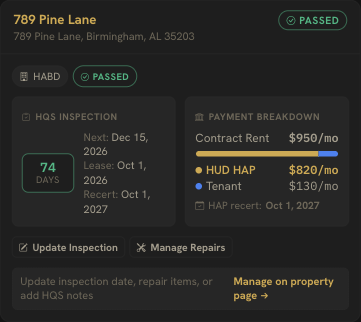
The FMR number also touches the rest of the owner system.
It affects projected rent. It affects cash flow. It affects PM statement review. It affects renewal timing. It affects bank reconciliation when HAP deposits hit. It affects the tax packet when rental income needs to tie back to actual deposits.
DoorVault is not a one feature filing cabinet. It connects documents, PM statements, bank activity, reports, loans, tax records, market data, Section 8 compliance, and Action Center follow up in one owner side system.
The property manager runs the property.
The owner still needs the asset record.
When to check FMR again
Check FMR when HUD publishes the new fiscal year data.
Check it before you list a Section 8 unit.
Check it before you submit a rent increase.
Check it before a renewal where the HAP split matters.
Check it when you buy in a new ZIP code.
And check the local housing authority schedule before you assume the HUD table is the number you can collect.
That rhythm is not hard. It is just easy to forget when the record lives across HUD tabs, PM emails, housing authority PDFs, and the owner’s spreadsheet.
The fix is not another tab.
The fix is one property record that knows the rent ceiling, the payment standard, the voucher proof, the inspection clock, the HAP deposits, and the documents behind all of it.
DoorVault keeps that owner side record in one place.
Free for 30 days. Every feature unlocked. No card. Then your first 2 doors stay free forever.
Start at https://doorvault.app.