
Rent minus mortgage is a cute number.
It is not cash flow.
That is the first rule of how to calculate cash flow on rental property once a property manager is involved. The formula is not hard. The receipts are hard.
Your PM statement says rent came in. Your bank says a deposit landed. Your loan record says escrow moved. Your insurance renewal says the cost changed. Your spreadsheet says everything is fine because nobody told it otherwise.
Very loyal spreadsheet. Terrible witness.
The math is not the problem
Rental property cash flow is the cash left after property income, operating costs, reserves, and debt service are counted.
The clean version looks like this:
Monthly rent plus other income, minus vacancy, PM fees, repairs, taxes, insurance, utilities, reserves, and mortgage payment.
That is the math.
Now the annoying part.
The mortgage payment is not one thing. Principal, interest, tax escrow, and insurance escrow do different jobs. A PM fee might be charged on collected rent, scheduled rent, or some mystery sentence from the management agreement. A reserve top up is not a repair, but it still changes the deposit you see. A leasing fee can make a good month look broken. A missing invoice can make a bad month look normal.
Say a property rents for $1,850.
The mortgage is $1,125. The owner says the property cash flows $725.
Cute.
Now subtract a 10% management fee, $185. Maintenance reserve, $130. Vacancy reserve, $90. Insurance increase, $65. PM repair coordination fee, $45. Escrow adjustment, $40.
The $725 became $170 before you even argue about capital reserves.
That is not a rounding error. That is a different decision.
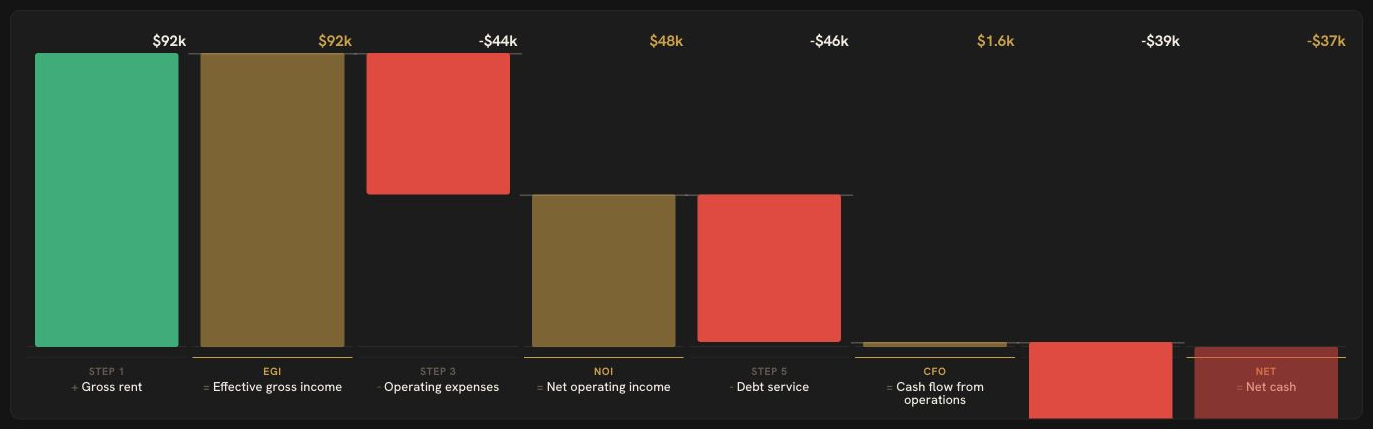
Your PM statement is only one witness
A PM statement is useful. It is not proof by itself.
The statement should show rent collected, fees charged, repairs, reserves, other charges, and the net owner payout. Then the bank should show the matching deposit. Then the invoice should explain the repair. Then the loan record should explain debt service and escrow. Then the per property P&L should show the same month in plain numbers.
One witness can be wrong.
Four witnesses agreeing is a system.
This is where owners get burned quietly. Not usually by fraud. Usually by tiny unglamorous gaps.
A $95 fee coded wrong for 6 months.
A $320 repair with no backup.
A reserve balance that moved but never got named.
A bank deposit that combines two properties, while the spreadsheet treats it like one.
“I’ll clean it up before taxes.”
Sure.
March is famous for creating spare time.
Cash flow needs a monthly close
The owner side monthly close should take about 15 minutes if the records are already flowing.
Here is the order.
First, match the PM statement to the bank deposit. If the statement says the payout was $2,650, the bank should show when that money landed and whether it was bundled with another property.
Second, split the mortgage payment. Interest belongs in operating records for tax. Principal changes the balance sheet. Escrow needs to tie back to taxes and insurance. Treating one PITI payment as one expense makes the number messy twice.
Third, separate recurring expenses from one time hits. A $780 water heater and a $780 monthly maintenance pattern are not the same problem.
Fourth, check reserves. Vacancy, maintenance, and capital reserves are boring until a roof decides to become a sentence in your checking account.
Fifth, compare the result to the trailing 12 months. One weak month is a month. Three weak months is a property asking for attention.
DoorVault exists for this exact owner close. Forward any property email, upload a file, or sync a folder. Knox reads PM statements, invoices, mortgage statements, insurance renewals, tax bills, leases, inspection reports, and closing documents. It files the proof to the right property and proposes the bookkeeping for review.
Bank reconciliation ties the statement to the real deposit. Mortgage splitting keeps principal, interest, taxes, and insurance from living in one mystery number. Reports Hub turns the records into per property P&L. The portfolio view shows cash flow, NOI, equity, debt, and occupancy in one owner record.
Manual PM statement reconciliation can take 30 to 60 minutes. DoorVault turns that into about 2 minutes of review.
Yeah. Boring. That is why it works.
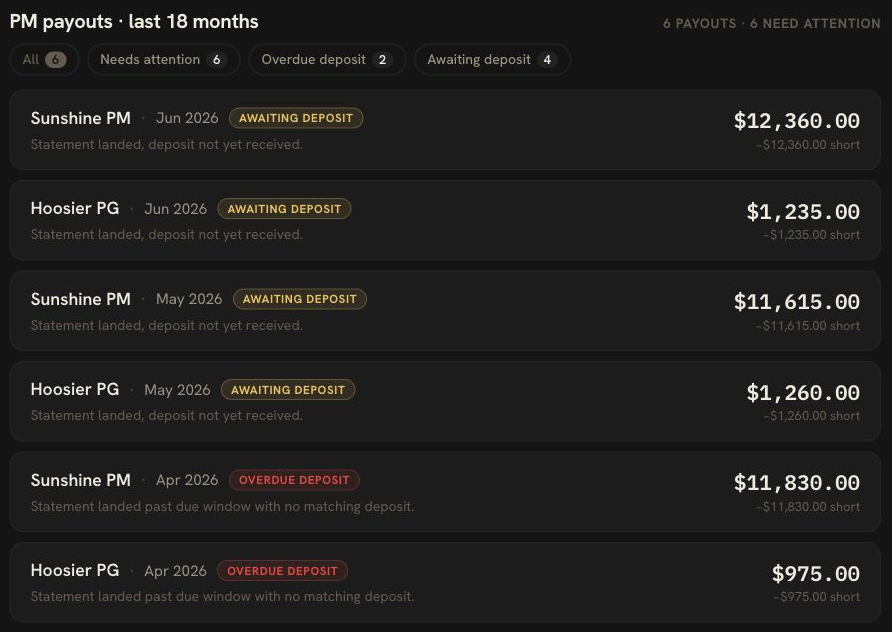
A cash flow number should survive a second question
A number is useful when it survives the next question.
The property shows $240 a month of cash flow. Great. What happens after the insurance renewal?
The PM statement shows $1,450 collected rent. Great. Did the bank receive the payout?
The dashboard shows positive cash flow. Great. Did you reserve for the turnover you know is coming?
The spreadsheet says door 4 is your winner. Great. Did it include the repair your PM billed late?
This is why rental cash flow is not only a buying metric. It is a live owner metric. The number should change as statements, deposits, loan balances, insurance, tax bills, and repairs change.
For owners with multiple PMs, this is the whole asset management gap. The PM runs the property. The owner still needs the money record, document record, loan record, tax record, and decision record to agree.
If your bigger issue is seeing NOI across more than one manager, start with track NOI across multiple property managers. If the data still lives inside PM portals, DoorVault Connect is the owner side sync path.
What is a good rental cash flow number?
A good rental cash flow number is one you can prove.
That sounds evasive. It is not.
On a property you are buying, the floor is $150 a month after everything. That is a hard gate, not a preference. A deal that pencils at $120 is a deal you talked yourself into.
On a property you already own, the question changes. $100 a month can still be worth holding if the equity is building, the records are clean, the tenant is stable, and the hold plan is real. $400 a month can be fiction if it ignores repairs, vacancy, reserves, escrow changes, and PM fees.
The floor screens what you buy. The proof decides what you keep.
For deal underwriting, many investors use quick rules before going deeper. The 50% rule estimates operating expenses at roughly half of rent before debt. The 2% rule screens rent against purchase price. People also ask about a 7% rule, which has no settled definition in real estate and is usually somebody’s yield preference wearing a rule’s clothing.
Fine. Use shortcuts for first pass filtering.
Do not use shortcuts to run the asset after closing.
After closing, the real question is not “what should cash flow be?” It is “what did this property actually produce after the records agree?”
DoorVault keeps that answer current, because Knox is reading the documents and the money trail as they arrive. You do not rebuild the month. You review what changed.
The next property should wait for the real number
Before you refinance, sell, hold, or buy the next door, make the number earn trust.
Can you tie rent collected to the statement?
Can you tie the statement to the bank deposit?
Can you tie every repair to backup?
Can you tie the mortgage payment to principal, interest, taxes, and insurance?
Can you open one place and see cash flow by property, not vibes by spreadsheet tab?
If yes, you have a cash flow number.
If no, you have a guess with formatting.
DoorVault is the AI asset manager for investors who use property managers. Your PM runs the property. Knox runs the asset record behind it.
Start at https://doorvault.app
FAQ
How do you calculate cash flow on a rental property?
Calculate rental cash flow by starting with rent and other income, then subtracting vacancy, PM fees, repairs, taxes, insurance, utilities, reserves, and debt service. For PM managed rentals, also match the PM statement to the bank deposit before trusting the number.
Is cash flow calculated before or after mortgage payments?
Cash flow is after debt service. NOI is before debt service. Owners need both because NOI shows the asset performance and cash flow shows what actually stays in the bank after the loan.
What is considered good cash flow for a rental property?
Good cash flow depends on the market, loan, equity, risk, and strategy. The better test is whether the number is proven from real statements, deposits, reserves, loan records, and expenses.
Why is my rental cash flow lower than expected?
Common causes include PM fees, repairs, vacancy, reserve top ups, insurance increases, escrow changes, tax bills, and deposits that do not match the statement month. Small gaps look harmless until they repeat.