
Rental Property Document Management: Why Your Owner Portal Is Not a Document Vault
Rental property document management usually gets framed like a folder problem.
It is not.
It is a trust problem.
If your lease, insurance declaration, closing disclosure, PM statement, or repair invoice takes more than 10 seconds to find, your portfolio does not have a system of record.
It has a scavenger hunt.
Your owner portal is a window, not a vault
Most investors assume the portal their property manager gives them is the place where everything lives.
That would be convenient.
It is also usually false.
The owner portal is built to show the PM’s work, not to become the investor’s long term source of truth. It is great at posting a monthly statement. It is much worse at being the place you can trust for every lease, every invoice, every renewal, every inspection report, and every lender request.
That gap gets expensive around door 5.
A 10 door portfolio can generate 30 to 50 property documents a month once you count statements, invoices, insurance notices, lease renewals, tax bills, escrow analyses, inspection reports, and closing paperwork. The portal might show some of them. Your email shows the rest. Google Drive catches a few more. Then March shows up and your CPA gets the archaeological dig version of your business.
One owner in our BiggerPockets research said the portal was mostly useful for downloading annual statements, while the real tracking still lived in Google Sheets.
That is the whole problem in one sentence.
The five documents that always go missing at the worst time
The missing file is never random.
It is always the one someone asked for today.
Usually one of these five:
- The signed lease when the PM changes hands and portal access shifts.
- The insurance declaration when renewal pricing jumps and the agent wants proof now.
- The closing disclosure when a lender asks for basis details before a refinance.
- The PM statement with the actual invoice behind a repair charge.
- The tax document or escrow notice that explains why cash flow moved this month.
These are not edge cases.
They are the boring documents that run the asset side of the business.
One owner in our portal research was told a rent roll could not be posted to the owner portal at all. Another could get the statement, but not the deeper records that explained it. That is why document chaos is not only annoying. It breaks verification. If the paper trail is fragmented, the numbers are fragile too.
The portal showed activity.
It did not preserve ownership.
Rental property document management is capture, not filing
This is where most advice gets lazy.
“Create a folder per property.”
“Name files consistently.”
“Use cloud storage.”
Fine. Do that.
That still does not solve the real problem.
The hard part is not where the file lives after you have it. The hard part is catching the file in the first place, classifying it correctly, tying it to the right property and entity, and making sure the rest of the portfolio updates when it lands.
That is why a real system has four jobs:
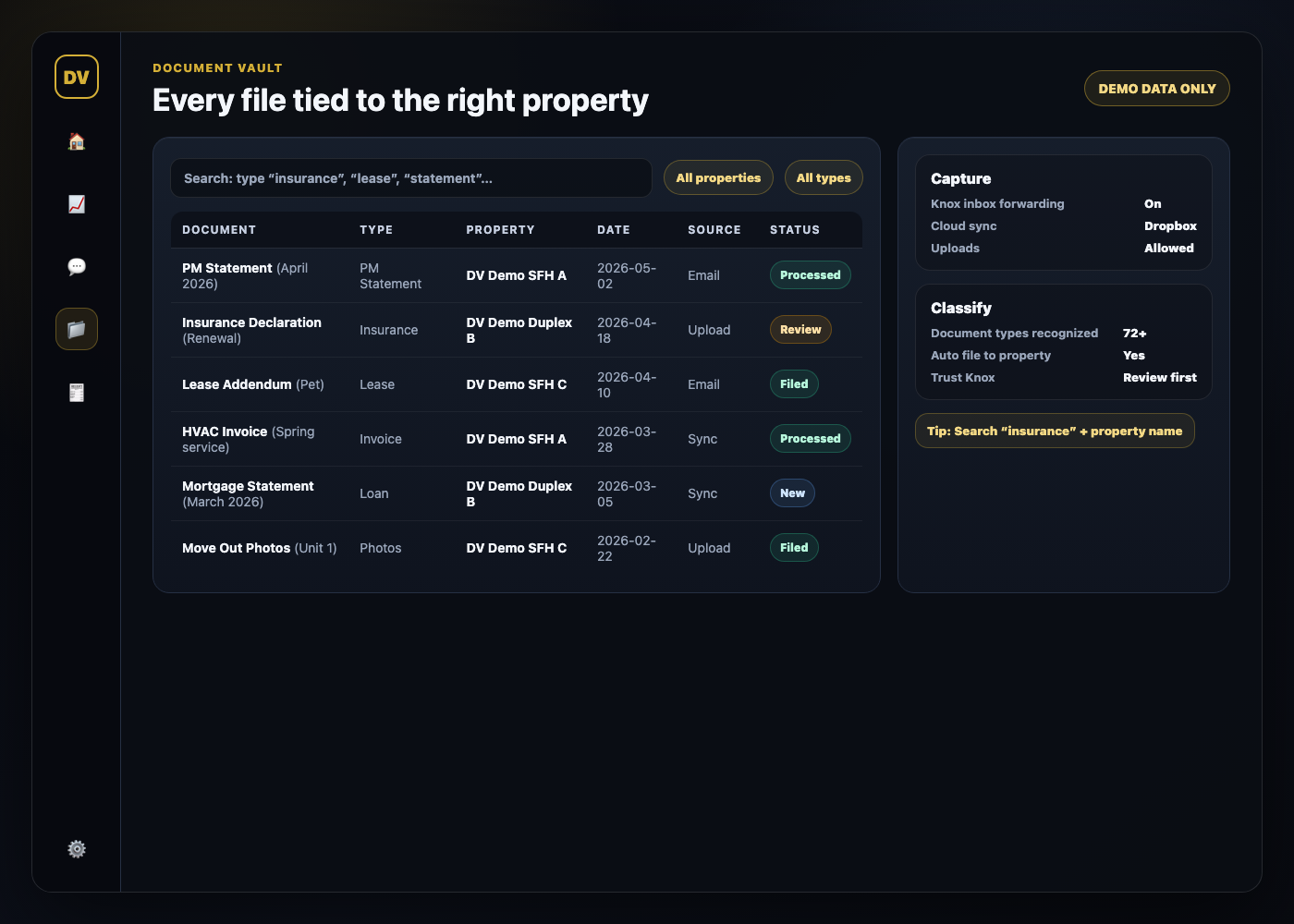
- Capture from the channels investors actually use, email, uploads, cloud folders, portal exports.
- Classify by property, entity, document type, and date without manual renaming.
- Retrieve in seconds when the lender, CPA, PM, or insurance agent asks.
- Trigger the next step, expiration tracking, transaction creation, loan updates, tax prep, or anomaly review.
Without step 4, you do not have document management.
You have storage.
Storage is not useless.
It is just not enough.
If you want the owner side checklist version of this problem, start with organize rental property documents.
What DoorVault updates after the document lands
Knox Intelligence is AI that proposes, learns, and never touches your data without permission.
That matters here because the win is not “we stored your PDF.”
The win is what happens next.
Forward any property related email to your Knox inbox, upload the file, or sync a cloud folder. Knox Document Intelligence reads 72 plus document types, files them to the right property, and extracts the fields that actually move the portfolio.
Then the rest of the system updates:
- PM statements become structured transactions through PM Statement Processing.
- Bank Reconciliation and Plaid Smart Sync can match the money movement to the statement month.
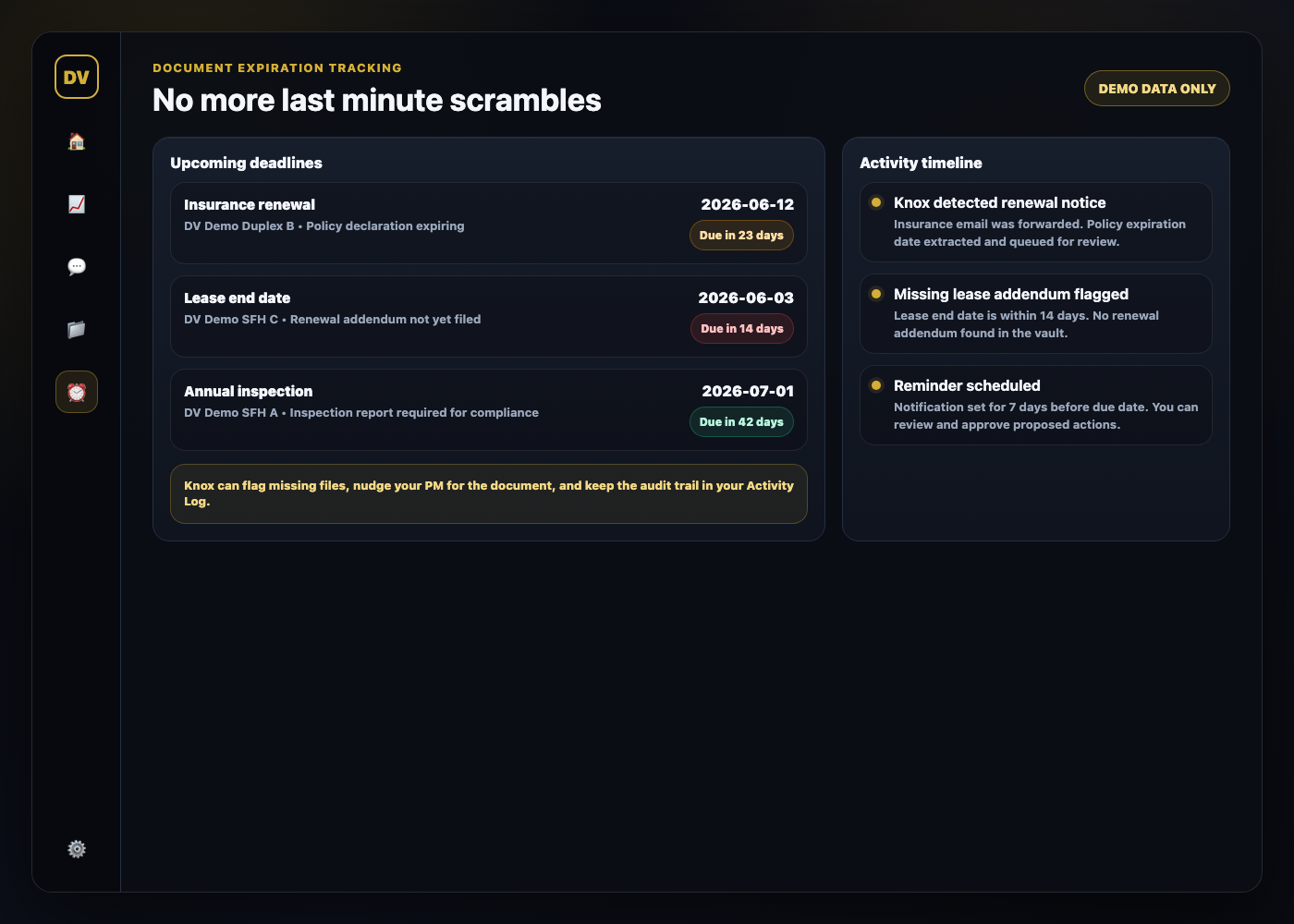
- Insurance notices and leases feed Document Expiration Tracking and Property Health Scores.
- Mortgage statements update the Loans Dashboard and keep payment splits clean for principal, interest, tax escrow, and insurance escrow.
- Closing disclosures and settlement statements keep acquisition data, equity context, and entity records current.
- Schedule E Export and the CPA Portal use the same categorized records later, instead of forcing a second cleanup project.
- The Activity Log keeps an audit trail on every change, and the Learning Loop remembers corrections so the next document gets cleaner.
That is the difference between a document vault and an owner side operating system.
The file does not go dark after upload.
It keeps working.
The 10 second test for whether your system is real
Try this with any property you own.
Set a timer for 10 seconds and answer one of these:
- Pull the current lease.
- Pull the latest insurance declaration.
- Pull the invoice behind last month’s biggest repair.
- Pull the closing disclosure.
- Pull the PM statement for the month the bank deposit looked off.
If the answer starts with “I think it is in…”
The system failed.
Not because you are disorganized.
Because the investor side was never given a real place to live.
DoorVault is built for that gap. Your property manager runs the property. DoorVault runs the asset side, the records, the verification, the deadlines, the returns, and the boring owner work nobody else volunteered to handle.
If you want the short version, this is it:
Documents arrive.
Knox catches them.
The portfolio updates.
You review what matters.
That is the whole thing.
FAQ
How should investors organize rental property documents?
Start by property and document type, but do not stop there. A real system also needs reliable capture, fast retrieval, and a way to turn documents into live portfolio records.
What documents should rental property owners keep?
At minimum, keep leases, PM statements, repair invoices, insurance declarations, tax documents, loan statements, inspection reports, and closing paperwork. The exact list expands as the portfolio gets more complex.
How long should you keep rental property documents?
Tax, legal, and lender retention rules vary by document and jurisdiction. Keep documents long enough to support tax filings, ownership history, insurance questions, audits, disputes, and refinance requests. When in doubt, ask your CPA or attorney and keep the digital record clean.
Why is an owner portal not enough?
Because the portal is usually designed around one PM’s workflow. Investors need a system of record across documents, money, loans, entities, and deadlines, even when more than one PM is involved.
If your portfolio still depends on memory, email search, and a folder called misc, start free with up to 2 properties at https://doorvault.app.