
Property Manager Maintenance Fees: How to Spot Markups and Stop Repair Costs From Eating Your Cash Flow
Property manager maintenance fees are one of the fastest ways for a rental to look fine on paper and quietly bleed you in real life.
Not because repairs are bad. Repairs are normal. The problem is that once you hand maintenance over to a property manager, your visibility usually drops to whatever shows up on a monthly owner statement. That is where small markups, coordination fees, and duplicate charges hide.
Why maintenance fees are where cash flow quietly dies
Maintenance is sneakier.
It shows up as a stream of 85 dollar trip charges, a 15 percent vendor markup, a 250 dollar “coordination fee,” and a few invoices that never make it to your inbox. None of those alone kills the deal. Together, they can turn 250 dollars a month of true cash flow into 80.
This hits harder as you add doors because you stop remembering what “normal” looks like for each asset.
If you are not tracking it, you are guessing.
The maintenance fee and markup menu: what you are actually paying for
The first mistake most owners make is assuming the monthly management fee covers everything related to maintenance. Usually it does not.
Common structures you will see:
Full fee map: Property manager fees: reasonable vs drift.
-
Maintenance coordination fee. A flat fee per work order, or a percentage on top of vendor invoices, charged for scheduling, supervising, and closing out repairs.
-
Vendor invoice markup. Often 10 to 20 percent. Some PMs do this openly. Others bury it inside “materials” or “admin.”
-
Trip charges. A fee for sending someone to the property for a lockout, inspection, or minor tenant issue.
-
In house maintenance. The PM uses their own crew and bills you a blended hourly rate plus materials. This can be fine, but you need clean invoices because it is easy for pricing to drift.
-
Approval thresholds. Many agreements let the PM approve repairs under a certain dollar amount without asking you. The threshold is not the problem. The lack of documentation is.
Do not fight every fee. Verify the pattern.
The owner side maintenance audit: 7 checks you can run in 10 minutes
This is the lightweight audit that keeps you in control without turning you into your PM’s accountant.
-
Invoice present for every charge. If the statement says “plumbing repair 275,” you should be able to click an attached invoice or work order. No invoice, no approval.
-
Work order ties to a real issue. Look for a short description that matches a tenant request, inspection item, or turnover scope. “Maintenance” is not a description.
-
Vendor consistency. Are you seeing the same vendor repeatedly for different problems, or different vendors for the same problem? Both can be red flags.
-
Frequency check. One repair is normal. Three repairs in one category in a quarter is a signal. A water heater that needs “minor” work every month is usually not minor.
-
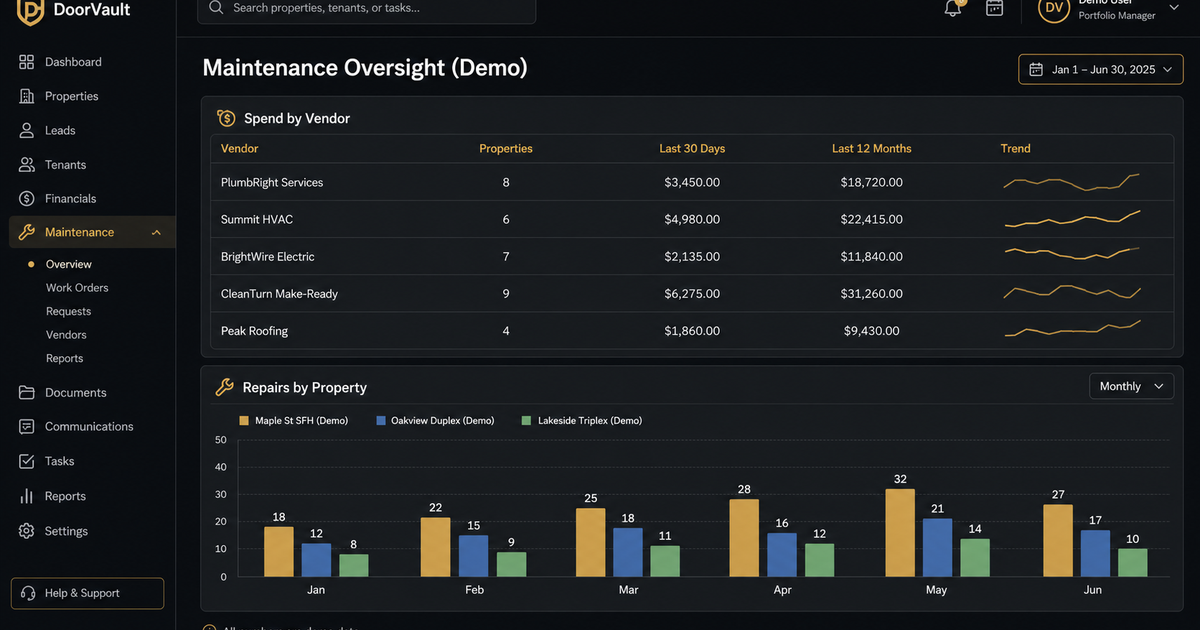
Cost trend vs the last 12 months. You do not need perfect benchmarking. You need a baseline. If a property averaged 90 dollars a month in repairs last year and it is now averaging 240, something changed.
-
Markup visibility. If your PM charges a maintenance markup, make sure it is a separate line item you can track. If it is hidden in the vendor line, you will never know your true maintenance cost.
-
Three way match. Statement, transactions, and bank deposits should agree. A repair charge is only real if it is recorded correctly and the math on the owner disbursement still checks out.
If you do these seven checks monthly, you catch cost creep early, while the fixes are still small.
Broader statement audit: PM statement audit checklist.
What to negotiate in your PM agreement so you can verify costs
Your goal is not to win the cheapest contract. Your goal is to win the clearest contract.
Here are the terms that make maintenance controllable:
-
Approval threshold with documentation. Keep the threshold, but require the invoice or work order to be attached for every charge, even under the threshold.
-
Markup disclosure. If there is a markup, it should be stated as a percentage and shown as its own line item.
-
Vendor choice rules. If you want approval on vendor changes or on any repair above a dollar amount, write it down.
-
Photo evidence for certain work. Turnovers, make ready work, and larger repairs should have before and after photos. This keeps disputes out of email threads later.
-
Reserve handling clarity. If you keep a reserve with the PM, the statement should show the reserve balance movement each month. If the reserve math is opaque, you cannot audit anything.
One practical example:
Assume a rental brings in 1,500 dollars a month. You net 250 dollars a month after all expenses in a normal month.
Now add a modest maintenance leak: 150 dollars of extra charges per month in a mix of markups and small invoices you would not have approved. That is 1,800 dollars a year.
On a property with 250 dollars a month of cash flow, that single leak cuts your annual cash flow by 60 percent. That is the difference between a portfolio that scales and a portfolio that stalls.
How DoorVault makes maintenance cost oversight automatic across a portfolio
Knox Intelligence is AI that proposes, learns, and never touches your data without permission.
In DoorVault, you do not start by building a spreadsheet. You start by routing the paperwork you already have.
Forward any property related email to your Knox inbox, upload a document, or sync a cloud folder. Knox reads the attachments, files invoices and statements to the correct property, and extracts the fields that matter for maintenance tracking.
Here is what that looks like in practice:
-
PM statements become structured transactions. Knox reads each line item, creates the repair transactions, and tags the vendor and category so you can see maintenance spend by property and by PM.
-
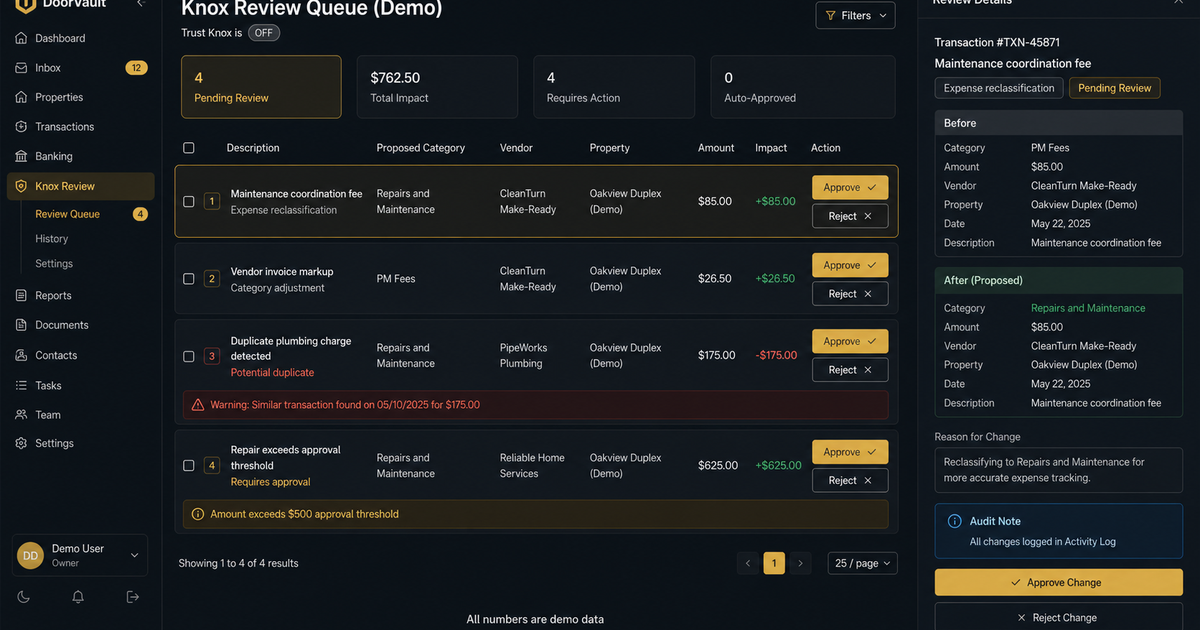
Markups and fees become trackable, not hidden. With Trust Knox OFF, Knox proposes how to classify a maintenance coordination fee or a markup line and you approve it. Correct it once and Knox remembers.
-
Patterns get flagged automatically. Knox Anomaly Detection highlights duplicates, spikes, and repeated vendor charges. You do not have to notice the pattern manually.
-
Everything is auditable. The Activity Log shows what changed and why, with before and after snapshots and one click revert.
-
You keep the full owner side view. The same system that tracks repairs also tracks loans, insurance renewals, tax categories, Section 8 compliance, and portfolio performance. Maintenance does not live in a silo. See the overview of DoorVault’s owner side workflow here: Property management statement reconciliation.
If you want to stay hands off, you do not need to read every invoice. You need a system that catches the exceptions, keeps the paper trail clean, and shows you where the money is leaking.
FAQ: property manager maintenance fees (quick answers)
What does the 80 20 rule mean in property management?
Most of the results come from a small number of actions. In rentals, a few properties and a few expense categories usually drive most of your outcomes.
Maintenance is a classic 80 20 area. A small number of recurring issues and vendors usually drive most of the cost. Track those patterns and you win.
What is the most common payment for a property manager?
Most residential PMs charge a monthly percentage of collected rent, plus separate fees for leasing, renewals, and certain maintenance activities.
If your only number is “10 percent,” you are missing the real cost picture.
Is 2 percent management fee high?
It depends on what you mean by 2 percent and how it is calculated.
Some owners confuse management fees with asset management fees, HOA fees, or even maintenance coordination fees that are charged as a percent of invoice volume. Always map every fee to a line item you can verify.
What is the 2 percent rule?
In real estate investing, “2 percent rule” often refers to a quick screen where monthly rent is at least 2 percent of the purchase price.
It can eliminate bad deals fast, but it does not protect you from owner side operational leaks like maintenance markup and fee drift.
The simplest next step
If you use property managers, maintenance is still your responsibility financially. The only question is whether you can see it clearly.
Start free. 2 properties. No credit card. → https://doorvault.app