
If your property manager is not sending monthly statements, that is the obvious problem.
The quieter problem is worse.
They send the statement. You get the PDF. The payout hits your bank. You skim the net number and move on because everyone is busy and the month looks normal.
That is how owner control dies politely.
Your property manager runs the property. You still own the asset. So every month, the PM owes you more than a summary. They owe you proof.
The statement is not the month
A monthly owner statement is one witness.
It is not the crime scene.
It tells you what the PM system says happened. Rent came in. Fees came out. Repairs were charged. Reserve money moved. A payout was sent.
Fine.
Now prove it.
The rent line should match tenant payments. The repair line should point to an invoice or work order. The reserve line should explain what was held, drawn, or topped up. The payout should match the bank deposit. The open items should tell you what still needs a decision.
If those pieces do not connect, the statement is not reporting.
It is a nicely formatted shrug.
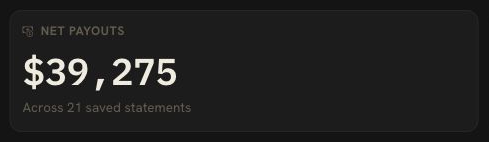
DoorVault keeps PM statement totals visible across saved statements, so payout patterns stop living inside one PDF at a time.
Five things belong in the packet
A useful monthly packet has 5 baseline pieces.
- Rent collected by property.
- Fees charged against the management agreement.
- Repair and maintenance detail with backup.
- Reserve beginning balance, draws, top ups, and ending balance.
- Net owner payout with the deposit date.
That is the floor.
Not a premium report. Not a courtesy. The floor.
The better packet also shows lease status, delinquency, vacancy days, renewal dates, inspection notes, and items waiting on owner approval. That does not mean the PM failed if it is not all in one PDF. It means the owner needs one place where all of it lands.
That is the part most owners miss.
They ask, did my PM send a statement?
The better question is, can I reconstruct the month without emailing anyone?
If the answer is no, you do not have a monthly close. You have a monthly attachment.
The payout has to match the bank
PM statement says $2,410.
Bank deposit says $2,265.
Nobody panics because $145 sounds small and there is probably a reason.
There might be. A reserve top up. A late invoice. A tenant short payment. A fee that belongs in the agreement. A fee that does not.
The point is not that every gap is theft. Most gaps are boring.
Boring is still money.
DoorVault reads the PM statement, pulls the payout line, and ties it to the bank deposit. If the statement says one number and the bank shows another, Knox keeps the difference visible instead of letting it vanish into tax season fog.
That is the owner side job.
Not distrusting the PM.
Verifying the asset.
Repairs need evidence, not adjectives
The weakest line on most statements is maintenance.
“Repairs.”
Cool. Did we repair a toilet, replace a condenser, patch drywall, clean a unit, or pay the PM cousin with a ladder?
Different nouns. Different tax treatment. Different lessons.
A repair charge should have a vendor, a date, a scope, an amount, and backup. If it crossed your approval threshold, it should also have proof you approved it. If the same issue repeats for 3 months, it should stop being a line item and start being a question.
“Maintenance, $487” is not a record.
It is an invoice shaped hole.
DoorVault files the PM statement, repair invoice, work order, and property record together. The clean number then rolls into your property view, your reports, and your tax prep without turning the blog into a feature inventory. The important part is simple: the repair has a trail.
Open questions belong on a decision list
The monthly packet should not only say what happened.
It should say what needs you.
Lease renewal due in 45 days. Reserve sitting above target. Repeat short rent. Insurance renewal not uploaded. Vacancy aging past the normal make ready window. Vendor paid past the tax form threshold. Statement arrived, but bank payout did not.
Those are not notes.
Those are owner decisions.
Most PM reporting buries them across email threads, portal tabs, and PDF footnotes. That is how small questions survive until they become expensive.
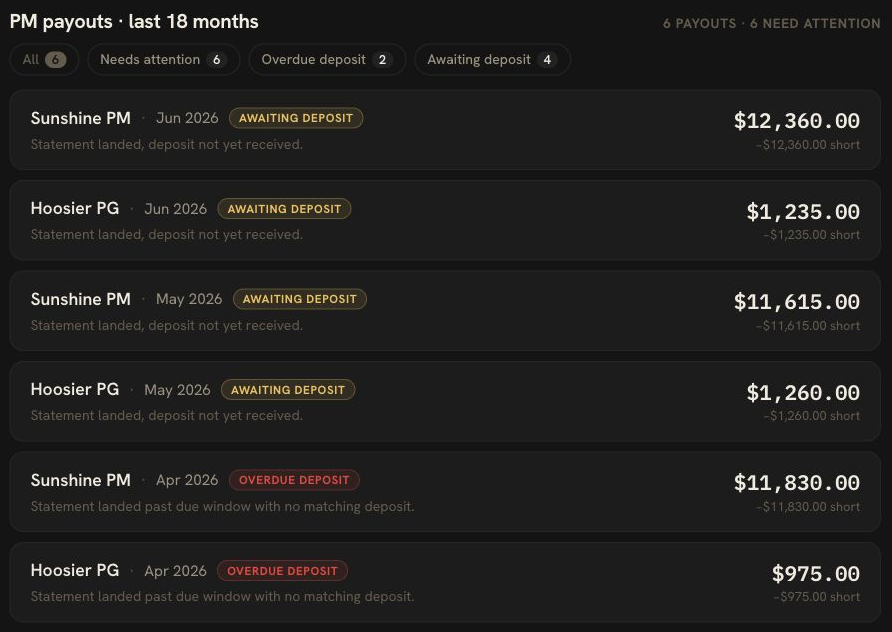
DoorVault keeps payout history and exceptions in the owner system, so the month closes around proof instead of memory.
DoorVault turns the packet into an owner system
DoorVault is the AI asset manager for investors who use property managers.
That means the monthly packet does not stop at the PDF.
Forward the PM email. Upload the invoice. Sync the folder. Connect the supported PM portal when available. Knox reads the documents, files them to the right property, proposes the transactions, ties payouts to bank activity, and keeps unresolved items visible until the owner decides.
The same owner system holds the broader asset record too. Property performance, loans, entity reporting, Section 8 records, BRRR tracking, Schedule E exports, insurance documents, and CPA access all work better when the monthly PM data is clean.
That is the difference between property management and asset management.
The PM runs tenants, repairs, notices, leasing, and local execution.
You still run the asset.
DoorVault gives the asset a real record.
Demand the packet. Keep the proof.
Ask your PM for the monthly packet before the month gets messy.
Rent collected. Fees. Repairs. Reserve movement. Net payout. Bank deposit. Open decisions.
If they already send it, great. Verify it.
If they do not, fix the standard now. The first month you cannot prove is the first month your numbers start lying to you.
Still closing rental months from PDFs and memory?
See Knox process the owner side of the month in 30 seconds → https://doorvault.app