
Tenant Turnover Cost: The $3,000 Line Item You Never Track (Until It Hits)
The month your tenant moves out is the month your cash flow story becomes fiction.
Because turnover is not one cost. It is five costs that show up across five inboxes, on five different days, with zero structure.
You see the vacancy first. Then you see a deposit that is short. Then you see a bundle of invoices labeled “make ready.” Then you try to remember which of those charges were normal, which were damage, and which were a quiet upgrade you will be depreciating for years.
Tenant turnover cost is the number that decides whether your rental is “cash flowing” or just not bleeding this month.
Turnover cost is not a line item. It is a formula.
If you only track vacancy, you miss the invoices.
If you only track the invoices, you miss the silent rent cut while the unit sits.
Here is the simplest formula that holds up in the real world:
Turnover cost =
1. Lost rent during vacancy
2. Make ready spend
3. Leasing or placement fees
4. Carrying costs while vacant
5. Admin time and chaos tax
On a $1,450 per month single family rental, a 28 day vacancy is about $1,350 of lost rent by itself.
Now add the stuff that always shows up:
- Cleaning: $275
- Paint touch ups: $450
- Lock change: $125
- Leasing fee: $1,450 (one month placement)
That is $3,810 before you even argue about whether the paint was “normal wear.”
If you own 10 doors and you have two turnovers in a quarter, you can erase an entire month of portfolio cash flow without realizing why.
The 5 buckets of turnover cost (with numbers you can actually use)
Most articles give you a range like $1,000 to $5,000.
That is true. It is also useless.
You need buckets you can tag.
Bucket 1: Lost rent
- Vacancy days times daily rent
- Example: $1,450 divided by 30 is $48 per day. A 28 day vacancy is $1,344.
Bucket 2: Make ready
- Cleaning, paint, flooring, minor repairs, trash out
- Example: $1,010 total across four invoices
Bucket 3: Leasing fees
- Placement fee, lease up fee, marketing fee, showing fee
- Example: 75 percent of one month rent is $1,088. One month is $1,450.
Bucket 4: Carrying costs
- Utilities you cover, lawn, HOA, insurance, taxes, interest
- Example: $210 in utilities and lawn plus $180 in HOA during the vacancy window
Bucket 5: Admin time
- Your time, your PM time, email chains, proof requests, photos, receipts
- Example: 6 hours of back and forth for one turn is not “free.”
If you do not break it into these buckets, you cannot compare anything month to month.
A real SFH turnover example that hurts (and why it matters)
Here is a clean, boring scenario with dummy numbers.
Nothing catastrophic. No eviction. No hoarder unit.
Just a normal move out and a normal “we will get it rent ready” process.
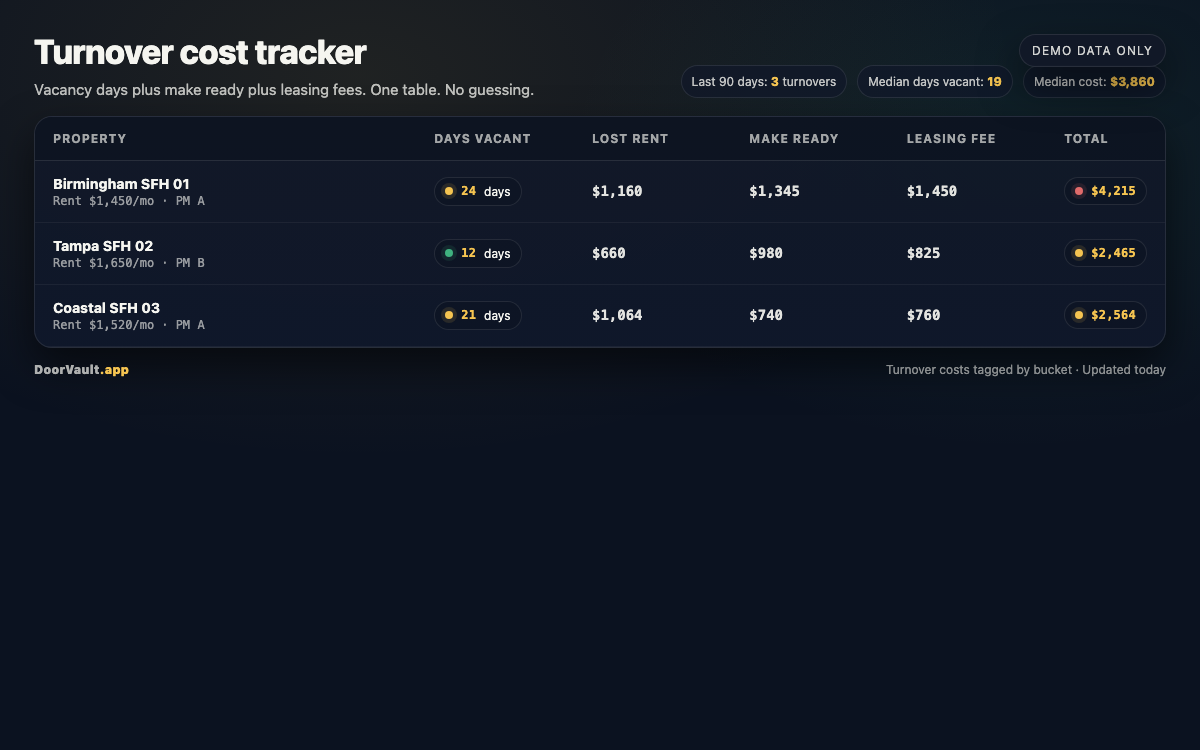
Rent: $1,450 per month
Vacancy: 24 days
- Lost rent: about $1,160
Make ready invoices:
- Cleaning: $275
- Paint: $650
- Minor repairs: $240
- Trash out: $180
Make ready total: $1,345
Leasing fee:
- One month placement: $1,450
Carrying costs during vacancy:
- Utilities and lawn: $260
Total turnover cost: $4,215
Now translate that into the only language your portfolio cares about.
$4,215 is 2.9 months of rent.
So when you underwrite a rental at “$250 per month cash flow,” one turnover can erase 17 months of that cash flow.
This is why the investors who scale stop talking about rent and start talking about systems.
The tracking system that makes turnover predictable (even with a PM)
If you use a property manager, your turnover packet is scattered by default.
The fix is simple. Not easy. Simple.
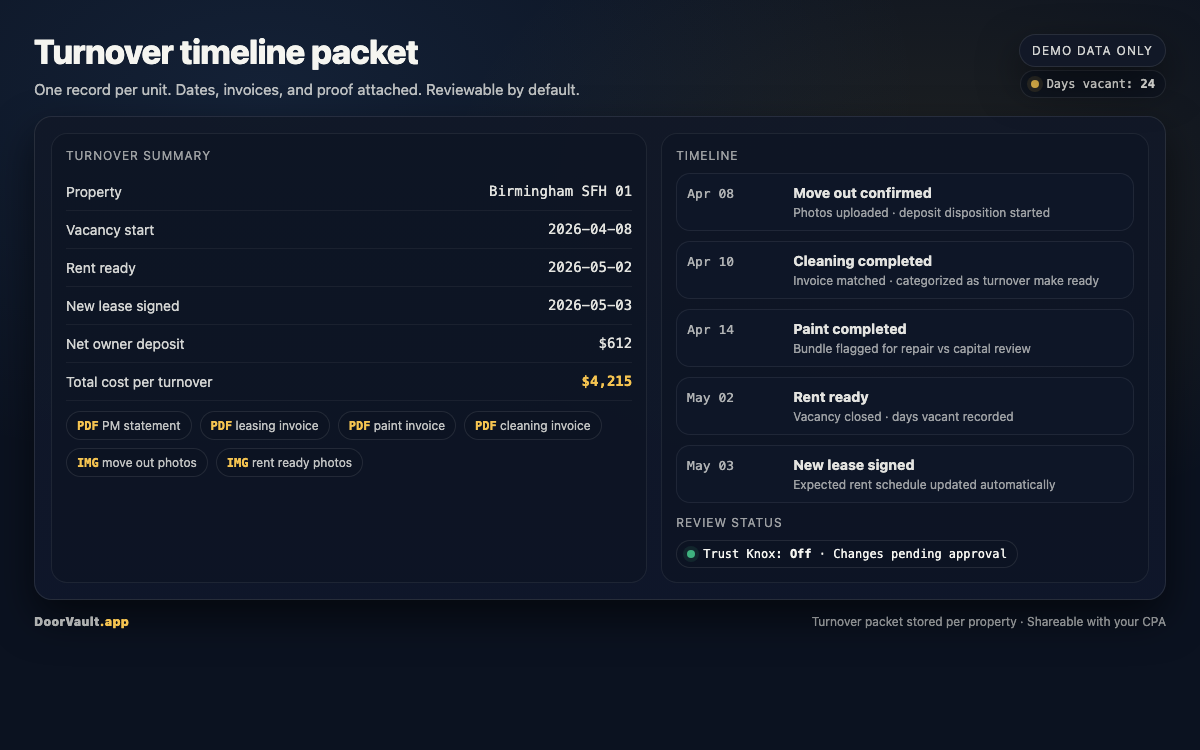
Every turnover needs three things tied together:
- A turnover event record for the unit
- Every document attached to that event
- A tagged cost roll up that matches your bank activity
If you do this, two things happen:
- You can answer “what did this turn actually cost” in 30 seconds
- You can compare turns across properties and across PMs without guessing
You do not need 30 categories. You need a few tags that do not lie:
- Turnover: vacancy loss
- Turnover: make ready
- Turnover: leasing fee
- Turnover: utilities and carrying
Then add two fields that force honesty:
- Vacancy start date
- Rent ready date
That is it.
If you want to go deeper, track one extra number: days vacant. Days vacant is the lever.
If your PM turns units in 12 days versus 35 days, your “turnover cost” changes even if the invoices are identical.
If you want a deeper breakdown on how vacancy quietly crushes NOI, read this: https://blog.doorvault.app/vacancy-rates-noi-impact-real-time
Where turnover math breaks with property managers (the net deposit trap)
The most common turnover mistake is not the paint bill.
It is the net deposit.
Tenant moves out.
PM collects last month rent, keeps the leasing fee, pays two vendors, and sends you the rest.
You get a deposit for $612 and you have no idea what it represents.
Two weeks later you get a statement that explains it. Sort of.
This is the moment most investors stop tracking and start shrugging.
Because the work required to reconcile it is annoying:
- Find the statement PDF
- Find the vendor invoices
- Match them to the bank
- Decide repair vs capital improvement for the bundle
- File everything somewhere you can find later
Do that across 8 properties and you will “do it later.”
Later becomes never.
This is also where repairs vs capital improvements gets messy.
Turnover bundles often include paint, flooring, appliances, and labor on one invoice.
If you want the cheat sheet for classification, read this: https://blog.doorvault.app/capital-improvements-vs-repairs-rental-property
How DoorVault keeps turnover from becoming a blind spot
DoorVault is built for the investor who already uses property managers and still ends up doing the owner side paperwork.
The promise is simple.
Upload, forward, or sync. Knox Intelligence does the extraction and filing. You only review what matters.
In a turnover, that means:
- Forward the PM email and vendor invoices to your Knox inbox, or sync a cloud folder (Knox reads 72 plus document types)
- Knox reads the documents, files them to the right property, and creates the transactions
- PM statements get processed line by line so “turnover” is not a vague label
- Bank activity gets matched via Plaid Smart Sync, or you upload a bank CSV and Knox matches it
- The capital improvement classifier flags when a turnover bundle should not be treated like routine repairs
- Your per property P and L shows the turnover hit as a real number, not a vibe
- Property health scores and expiration tracking nudge you before the next turnover, not after it
- When tax season shows up, Schedule E export is one click per property with clean categories
Turnover tracking is one entry point. The same system also handles loans, equity, entity reporting across LLCs, Section 8 compliance paperwork, BRRR pipeline tracking, and 1031 deadlines.
If you want a second example of a clean owner system that prevents surprises, this reserve fund guide pairs well with turnover tracking: https://blog.doorvault.app/property-management-reserve-fund-how-much-to-keep-and-track
FAQ: tenant turnover cost
What is a good tenant turnover rate?
It depends on property type and tenant profile, but the owner side question is simpler.
Do you know your turnover rate per property, and do you know your cost per turnover within $500?
If you cannot answer those two, you are not tracking turnover. You are reacting to it.
How much do turnovers cost?
For many single family rentals, a normal turnover lands between $2,000 and $5,000 once you include lost rent, make ready, and leasing fees.
The fastest way to lower it is not negotiating paint.
It is reducing vacancy days.
What is the estimated average cost of a single tenant turnover in 2026?
If your rent is $1,400 to $2,000, a “normal” turnover commonly lands around one to three months of rent once you add up the real buckets.
The exact number does not matter as much as having a system that makes your number visible.
What is the 30% rule for apartments?
That rule is a tenant affordability heuristic. It is not a turnover planning tool.
As an owner, the better heuristic is this:
Assume at least one month of rent per turnover in total cost until your own data proves otherwise.
The bottom line
Tenant turnover cost is not unpredictable.
It is untracked.
If you want to stop treating turnovers like random weather, build a system that attaches every invoice and every day vacant to a single turnover record per unit.
DoorVault does this automatically.
Start free on 2 properties, no credit card, at https://doorvault.app