
The property manager fee is the number everyone stares at.
It is rarely the expensive number.
Owners compare 8 percent to 10 percent like the decision lives inside two digits. The cheaper quote feels responsible. The higher quote feels like drag. The spreadsheet nods along.
Fine.
Now ask the boring question.
After you hire the manager, who proves the month?
Because the PM fee is visible. The owner verification cost is not. It shows up later as statement reviews, repair questions, missing invoices, reserve confusion, payout gaps, tax cleanup, and the familiar Friday afternoon email that starts with, “Can you remind me what this charge was?”
That is the number worth comparing.
The quote is only the first number
Most property manager fee searches begin with the visible charge. A monthly management fee might be a percentage of collected rent. Other fees might cover leasing, renewal, setup, inspections, maintenance coordination, or admin work.
You should read every line.
But the fee schedule is not the operating system.
On $1,700 of monthly rent, a 10 percent management fee is $170. Across 10 similar doors, that is $1,700 a month before leasing fees, repair coordination, or renewal charges. The math is not hard. That is why owners like it.
The dangerous part is the number behind it.
Can you tell whether the fee was charged only on collected rent? Can you see whether a repair markup matches the agreement? Can you tie the owner payout to the bank deposit? Can you tell whether reserve money moved for a reason or just because the statement says so?
If not, you did not choose a cheap PM.
You bought a monthly close you still have to finish.
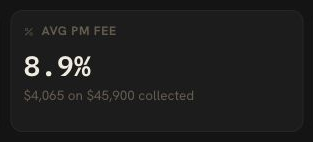
DoorVault keeps PM fee percentage and total fees visible across saved statements, so the owner is not rebuilding the fee story one PDF at a time.
The second number is owner verification
The second number is the time and risk that stays with you.
Call it the owner verification cost.
Every month, a PM managed owner still has to answer six questions:
- Did rent collected match the statement?
- Did every fee match the agreement?
- Did repairs include backup?
- Did reserve movement make sense?
- Did the owner payout match the bank deposit?
- Did open decisions stay visible?
Six checks. Twelve months. Seventy two owner checks per property per year.
That is before tax prep, loan reporting, entity records, insurance renewals, lease files, CPA questions, and the random repair invoice that appears three months after the work was done.
Nobody puts that number in the PM proposal.
They should.
An owner who spends 20 minutes closing one property month has a cost. An owner who ignores the close also has a cost. It just waits until refinance, sale, tax season, lender diligence, or a PM breakup to introduce itself.
Yeah. Polite disaster with a PDF attachment.
A lower fee can hide a larger close
The cheaper PM is not automatically worse. The higher fee PM is not automatically better.
The question is whether the monthly proof arrives clean.
An 8 percent manager with vague statements can cost more than a 10 percent manager whose packet shows rent collected, fees charged, repairs, reserves, net payout, bank deposit, and open owner decisions in a format you can actually review.
Here is the operator test.
PM statement says the owner payout is $2,410.
Bank deposit says $2,265.
That $145 gap might be fine. Reserve top up. Late invoice. Short rent. Bank timing. A fee that belongs in the agreement.
Or not.
The point is not to assume the manager is wrong.
The point is to stop pretending the month closed because a statement arrived.
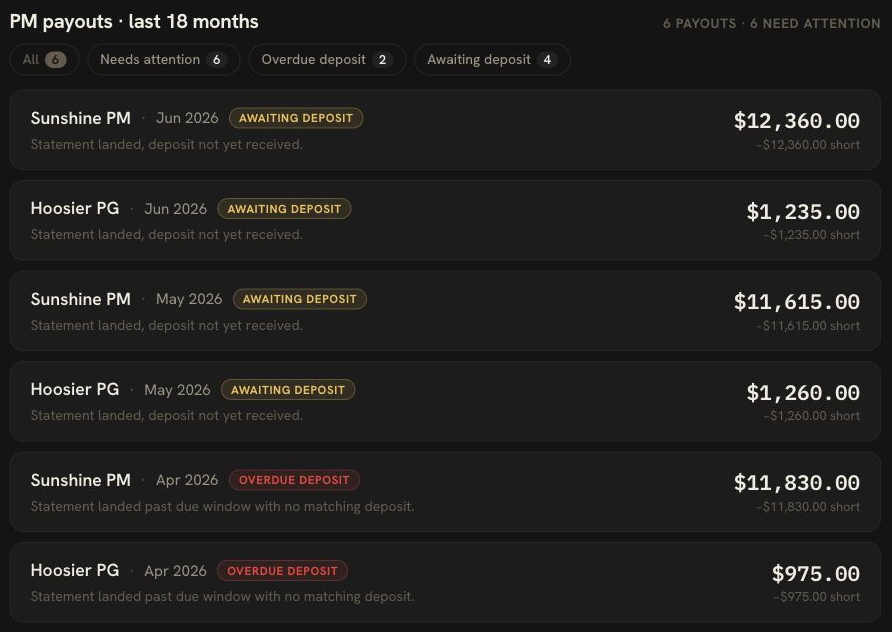
DoorVault keeps expected PM payouts and bank deposit status visible together, so payout questions do not drift into tax season.
DoorVault keeps the fee in context
DoorVault is the AI asset manager for investors who use property managers.
That means the PM can still run tenants, leasing, repairs, notices, inspections, and local execution. Good. That is the job.
The owner still needs the asset record.
Knox reads the PM statement, files the document to the right property, pulls the fee and payout lines, ties the expected owner payout to bank activity, and keeps unresolved items visible in the Action Center until the owner decides.
That is the PM oversight layer.
The same record matters beyond the statement. Reports Hub needs clean income and expense data. Schedule E exports need repair categories that make sense. Loans need current property context. Entities need clean ownership records. Insurance, leases, closing documents, inspections, and CPA access all work better when the monthly PM data is not trapped in portals and PDFs.
This is the part fee comparisons usually miss.
You are not just buying tenant operations.
You are deciding how much owner proof you will still have to rebuild.
The hiring question changes
Do not ask only, “What do you charge?”
Ask, “What will I be able to prove every month without chasing you?”
Then ask for a sample owner packet.
Not a marketing screenshot. Not a promise. A real sample packet with rent collected, PM fees, repair backup, reserve movement, net owner payout, deposit timing, and open owner decisions.
If the packet is clear, the fee is comparable.
If the packet is vague, the fee is theater.
That is the whole point.
The PM can run the property. DoorVault keeps the owner side clean after the manager does the daily work.
Still comparing property managers by the visible fee only?
See Knox process the owner side of a PM month in 30 seconds → https://doorvault.app