
The worst property management agreement red flags do not look scary.
They look like paragraph 8, subsection C, written by someone allergic to sunlight.
Then 6 months later, rent came in, repairs posted, reserves moved, the owner payout shrank, and everyone points at the agreement like it was always obvious.
That is the trap.
The clause is not the whole risk. The risk is a clause you cannot verify when the monthly statement lands. If the agreement lets the PM charge a fee, raise a reserve, approve a repair, hold money, or delay a draw, the owner needs a record that proves what happened.
Your property manager runs the property. DoorVault runs the asset record.
The clause is boring until it touches cash
A clean management agreement should answer ordinary questions in plain language.
What is the base fee? What is the leasing fee? What is the renewal fee? What repair amount needs owner approval? How much reserve can the manager hold? When does the owner payout go out? What records come back if you leave?
Nothing glamorous.
Good.
Boring is what you want in a contract.
The red flags are the vague versions: fees determined by manager, repairs approved as needed, administrative charges may apply, reserve may be adjusted, records available upon request.
That is not proof. That is fog with a signature line.
Ask one question for every clause: how will this show up on my owner statement and bank deposit?
If the answer requires 3 emails, a portal export, a bank search, and your memory from last month, the clause already owns part of your calendar.
Fee language decides what rent survives
Start with the fee section because rent does not become owner cash by magic.
A management fee based on collected rent is different from one based on scheduled rent. A renewal fee can be fine when it replaces real leasing work. It gets less cute when it appears without a clear service. Admin fees, portal fees, inspection fees, vacancy fees, and maintenance coordination fees can be reasonable.
They can also become the quiet leak.
Say the rent line is $1,700. An 8 percent management fee is $136. Add a $25 admin fee, a $75 vacancy fee, and a 10 percent markup on a $900 repair invoice. Your owner payout moved by $326 before reserves enter the picture.
That is not drama.
It is arithmetic wearing khakis.
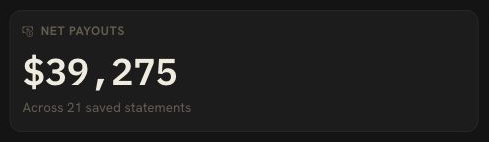
DoorVault keeps those lines attached to the PM statement, property, document, category, and owner payout, so the owner can see whether the contract language became the right cash result.
Repair authority needs a number and a receipt
Repair approval language should have a dollar amount.
Many PM agreements let the manager approve ordinary repairs up to a threshold without calling the owner. That can be the right model. Nobody wants a broken lock waiting for a committee meeting.
The risk is open authority.
If the agreement says the manager may approve repairs as needed, ask for a cap, an emergency rule, and an evidence rule. A common owner review threshold sits around $250 to $500, depending on the property, market, and manager. The exact number matters less than the proof standard.
Every repair charge should tie to 5 records:
- The agreement authority.
- The work order or maintenance note.
- The vendor invoice.
- The PM statement line.
- The owner payout and bank result.
If a $475 repair can appear as one statement line with no invoice, the owner does not have oversight.
The owner has a receipt shaped mystery.
DoorVault stores repair invoices, reads PM statement lines, links documents to the right property, and keeps review items in Action Center when something needs a manager answer.
Reserves should never be a fog machine
Reserves sound harmless because the money still belongs to you.
Until nobody can explain where it went.
A good agreement states the reserve amount, the property it belongs to, when it must be replenished, when it can be raised, and how releases appear on the statement. A weak agreement lets reserve changes hide inside monthly cash flow.
Example: the PM increases a reserve from $500 to $750 after a repair month. That $250 might be valid. It might be a reserve top up. It might be a withheld payout. It might be a repair payment. It might be a timing issue.
Those are 4 different stories.
Only one can be true.
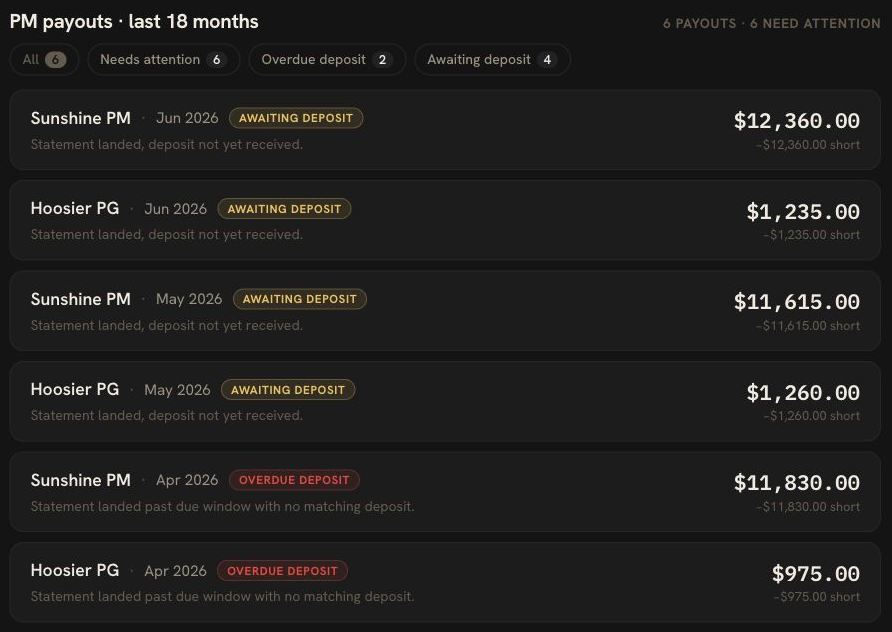
DoorVault PM payout reconciliation compares the expected owner payout to the bank deposit and keeps the mismatch visible until it has a name. If a reserve move explains the gap, great. If not, the question goes back to the PM with the right evidence attached.
The agreement should create a monthly proof packet
The best contract clause creates a shared record.
The worst clause creates another email thread.
Before signing, ask for the monthly owner packet the PM expects you to rely on. Not a sales sample. A real anonymized packet or demo packet showing rent collected, PM fees, repair backup, reserve movement, net owner payout, deposit timing, lease documents, and open owner decisions.
Then ask what you receive if you leave.
Cancellation terms matter, but the handoff matters too. Your owner record should not live only inside a manager portal that disappears when you change managers. You need leases, ledgers, invoices, insurance docs, inspection notes, deposit records, tax categories, and property files in your own system.
DoorVault gives owners that independent owner side file. PM emails can be forwarded in. Owner statements can be uploaded. Documents can be sorted by property. Knox Portfolio Audit can check missing records, stale items, fee drift, statement gaps, and payout mismatches.
Yes, that is boring.
That is the point.
The owner system matters after the ink dries
Here is the pre signing checklist:
- What fee basis is used for monthly management fees?
- Which extra fees can hit an owner statement?
- What repair amount needs owner approval?
- What counts as an emergency?
- How are maintenance markups disclosed?
- How are reserves funded, raised, and released?
- When are owner payouts sent?
- What support arrives with every fee line?
- What records do I receive if I cancel?
- Can I verify the agreement against a real owner packet?
Strong managers usually answer these cleanly. They know a clear owner is easier to work with than an owner who discovers every question 90 days late.
Weak answers are useful too.
They save you from signing.
For a deeper diligence packet, read the real owner packet checklist. For specific fee lines, start with the maintenance markup guide and the vacancy fee audit.
The agreement is not paperwork. It is the rulebook for your owner payout.
Use DoorVault to keep that rulebook beside the statement, invoice trail, bank deposit, property record, reports, tax files, and task history. When a clause turns into a charge, you should not have to rebuild the month from memory.
Start with the PM statement. Forward it, upload it, or sync the folder at https://doorvault.app.
FAQs
What are property management agreement red flags?
Property management agreement red flags include vague fee language, no repair approval limit, unclear maintenance markup rules, broad reserve authority, weak cancellation terms, and no clear record handoff if the owner changes managers.
What fees should an owner check in a property management agreement?
Check the monthly management fee, tenant placement fee, renewal fee, vacancy fee, admin fee, owner portal fee, inspection fee, maintenance markup, lease fee, cancellation fee, and any statement or document fee.
What repair approval limit should a property manager have?
The right repair approval limit depends on the property and market. Many owners use a written threshold around $250 to $500, with a separate emergency exception and a clear invoice rule.
Can an owner get out of a property management contract?
Usually yes, but the contract controls notice, fees, timing, and record handoff. Read the cancellation section before signing, not after the relationship is already strained.
How does DoorVault help verify PM contract clauses?
DoorVault keeps the PM agreement, owner statement, invoice, reserve movement, property record, bank payout, reports, tax files, and follow up task connected, so the owner can check whether a contract clause became the right payout.