
The Property Manager Maintenance Markup Nobody Checks
A property manager maintenance markup is not automatically a scandal.
That is what makes it easy to miss.
A plumber sends a $400 invoice. The owner statement shows $440. Maybe the 10 percent markup is allowed. Maybe it is not. Maybe the PM agreement says yes, the vendor invoice proves it, and the bank payout ties out cleanly.
Or maybe one boring repair line became your books because nobody wanted to read the PDF.
DoorVault was built for this owner problem. Your property manager runs the property. DoorVault runs the asset record that checks the agreement, statement, invoice, payout, and tax trail.
A 10 percent markup is not the crime
A repair markup is usually a coordination fee.
The PM schedules the vendor, answers tenant messages, approves the work, reviews the invoice, and gets the repair closed. That work has value. A disclosed fee can be completely normal.
The problem is not the existence of a markup.
The problem is the fog around it.
A $400 repair plus 10 percent becomes $440. A $2,500 repair plus 10 percent becomes $2,750. If the agreement clearly says the PM charges 10 percent on vendor invoices, fine. Pay the fee and move on.
If the agreement is silent, vague, or sitting in a folder nobody opens, the markup has not earned trust. It has borrowed it.
That is where owners get clipped. The statement looks tidy. The repair looks normal. The bank deposit still lands. Everybody moves on.
Excel nods politely and accepts whatever number you typed.
Very official. Very dangerous.
The invoice is only one piece of the math
Most owners check the wrong thing.
They look at the owner statement and ask, did the math work?
Better question: did the evidence work?
For a maintenance markup, you need four items to agree.
- The PM agreement says the markup is allowed.
- The vendor invoice shows the original repair amount.
- The owner statement shows the markup once and assigns it to the right property.
- The bank payout reflects the net number once.
If one of those is missing, you do not have a clean repair record. You have a formatted guess.
This matters most when one PM deposit covers several properties. A single $6,800 bank deposit might include rent, repairs, reserves, management fees, and multiple repair markups across several homes. The bank can confirm the total landed. It cannot tell you whether the $440 repair line belonged on Maple Street or Pine Street.
That is the owner side problem. The PM runs the repair. You still need the record that proves what happened to your money.

The 4 line audit catches the quiet leak
The audit is not complicated.
Boring, yes. Complicated, no.
Make one row per repair and check four columns.
Agreement. Find the exact maintenance markup clause. Not a memory of the sales call. Not a line in an email. The agreement.
Invoice. Save the vendor invoice. If the statement says $440, the invoice should explain whether the vendor billed $400 and the PM added 10 percent, or whether the vendor billed $440 directly.
Statement. Check property, date, amount, and category. A repair on one home should not drift into another home because the PM statement format is messy.
Bank. Confirm the net payout includes the charge once. Not zero times. Not twice. Once.
That is it.
Agreement. Invoice. Statement. Bank.
Four lines beat a year end archaeology project every time.
For the broader monthly loop, start with PM statement reconciliation. The markup is one line. The habit is the whole system.
DoorVault keeps the repair tied to the evidence
DoorVault makes the repair line prove itself.
Forward the PM statement, upload the vendor invoice, or sync the folder where the documents land. Knox reads the statement line by line. Rent, PM fees, maintenance charges, reserves, other charges, and net payout become structured records tied to the right property.
Then the proof stays attached.
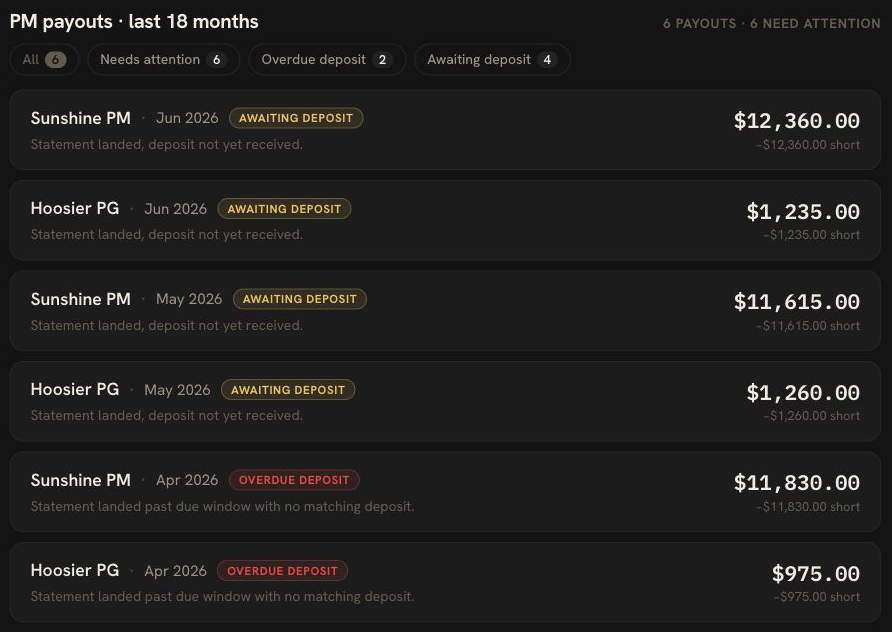
The PM agreement lives in the Document Vault. The vendor invoice stays with the repair. The owner statement is filed by property and month. The payout gets matched against the bank. If something does not tie out, it does not become a quiet little mystery waiting for April.
It waits for review.
The PM Report Card makes fee patterns visible across managers. The Activity Log records what Knox proposed, what you approved, and what changed. The property P and L updates from the cleaned record, not from a PDF you meant to review later.
Forward the email. Review the exception. Move on.
Yeah. That is the workflow.
The tax record inherits whatever you ignored
Maintenance markup mistakes do not stay in the month they happened.
They become expenses.
If the markup is valid, it belongs in the right property record. If it is invalid, duplicated, or assigned to the wrong home, it should not become a Schedule E expense because nobody wanted to ask the PM for the invoice.
That is the part owners underestimate.
One $40 markup is not dramatic. Ten unclear repair charges across the year become a tax record your CPA has to decode. The CPA was not there when the statement arrived. The PM agreement was not attached to the spreadsheet. The invoice is in an email thread from seven months ago with the subject line "quick update."
Excellent filing system. Museum quality.
DoorVault keeps the chain together while the month is fresh. The statement is filed. The invoice is attached. The payout is matched. The repair hits the right property. The Schedule E export gets cleaner inputs because the owner record did not rot in an inbox.
And this is one boring repair line. Knox also reads 72 plus document types, processes property emails, files insurance renewals and leases, splits mortgage payments, tracks loans and equity, watches Section 8 deadlines, supports entity reporting, and gets the CPA packet ready.
The point is not the markup.
The point is that the markup exposes the whole problem. Your PM runs the property. You still need an owner side system that checks the asset.
For a faster version of this audit, use the PM statement audit tool.
FAQ: property manager maintenance markup
What is a property manager maintenance markup?
A property manager maintenance markup is an added percentage on top of a vendor repair invoice. It usually pays the PM for coordinating the repair, communicating with the tenant, reviewing the invoice, and closing the work order.
Is a maintenance markup always bad?
No. A disclosed markup can be normal. The issue is whether the PM agreement allows it, the vendor invoice supports it, the owner statement shows it correctly, and the bank payout reflects it once.
How much does a 10 percent markup cost?
A $400 invoice becomes $440. A $2,500 invoice becomes $2,750. The number is not hard. The proof chain is where owners usually lose the plot.
What should owners check first?
Check the PM agreement first, then the vendor invoice, then the owner statement, then the bank payout. If all four agree, the charge probably belongs. If one is missing, review it before it becomes your books.
Still accepting repair markups because the statement balances? Start free. 2 properties. No credit card. https://doorvault.app