
Best Section 8 Markets: How to Compare Cities Like Jackson vs Cleveland (2026 Checklist)
If you search “best section 8 markets,” you get a bunch of ranked lists.
What you do not get is a repeatable way to compare two cities so you do not buy into a market that looks great on rent and price, then bleeds you on inspections, turnovers, and owner side chaos.
This matters even more if you use property managers. Your risk is not “can I collect rent.” Your risk is “can I see what is happening fast enough to make good decisions across markets.”
Why “best markets” lists break in the real world
Most lists rank markets on two numbers.
- Voucher rent looks high.
- Purchase prices look low.
That is a start, but it is not the job.
The job is building a portfolio that stays boring month after month.
Here is what the lists usually miss.
- Operational friction. Two markets can have similar voucher rent, but wildly different inspection bottlenecks and reinspection timelines.
- Property manager variance. A market with cheap homes is not a deal if the only decent PMs are overloaded and slow.
- Owner side visibility. If your vouchers, inspections, documents, and PM statements live in five portals and three inboxes, you will not catch problems early.
That is why the best Section 8 market is not the one with the highest rent number. It is the one where the math works and the operations stay under control.
The Section 8 market scorecard: 6 numbers to compare any two cities
You do not need a “top 15 markets” list. You need a scorecard you can run on any city in 15 minutes.
1) FMR to price ratio
Start with a rough “rent to price” signal using HUD Fair Market Rent as your rent anchor.
DoorVault’s 2026 Section 8 research uses a simple threshold: markets where the FMR to price ratio is above 1 percent tend to be where Section 8 math starts to outperform conventional rentals. It is not a guarantee. It is a fast filter.
If you do not have this ratio, you are guessing.
2) Inspection friction
Every market has inspections. The question is how predictable they are.
Track:
- average time from request to inspection
- average time from failed inspection to reinspection
- most common fail reasons for your property type and neighborhood
A market where you lose two weeks of rent every time an inspector reschedules is not “passive” no matter how good the headline returns look.
3) Payment reliability
Section 8 is famous for reliable payments, but you still need to know:
- when HAP deposits usually land
- how often the housing authority pays late
- what triggers holds or partial payments in that jurisdiction
The goal is setting expectations and catching exceptions fast.
4) Tenant portion risk
If a market’s payment standard is tight relative to market rent, more of your rent comes from the tenant portion.
That changes your risk profile and your leasing process.
5) PM coverage
Ask a blunt question.
If your PM quits tomorrow, do you have two other options you would trust with your asset?
Markets where the PM bench is thin create a hidden concentration risk. One bad PM relationship can stall an entire expansion plan.
6) Exit liquidity
You might love Section 8, then decide later you want to convert to conventional, refinance, or sell.
The best Section 8 markets are not only good on cash flow. They also give you options.
Score:
- days on market for entry level homes
- buyer demand for rentals in the neighborhoods you target
- how “voucher heavy” the area is and what that does to buyer pool
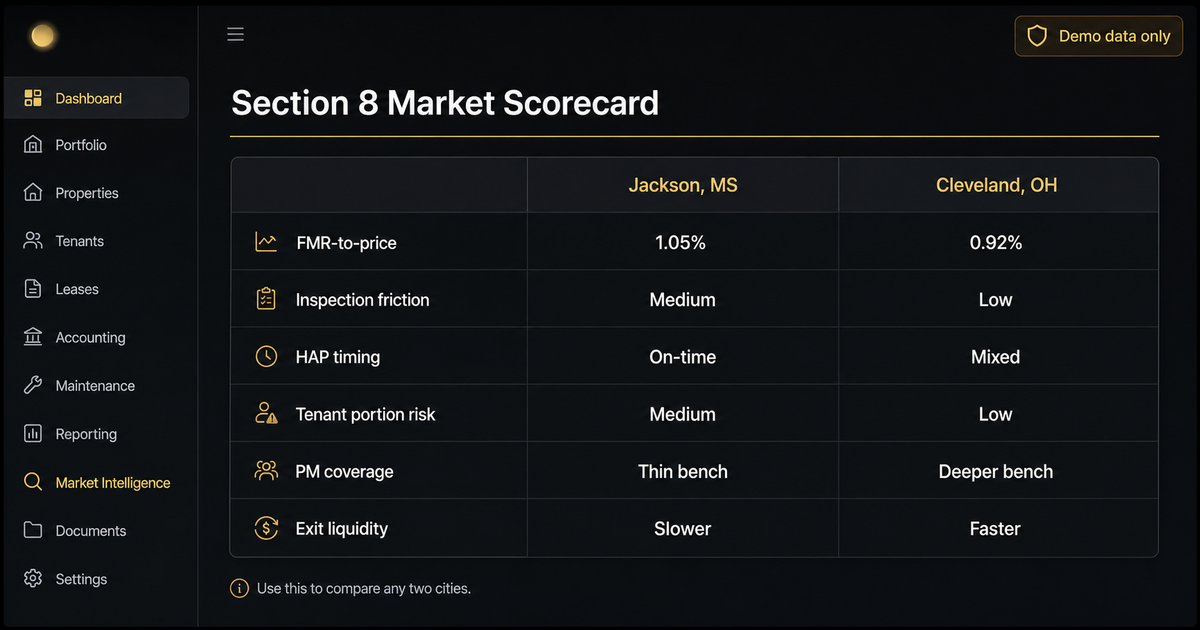
Jackson vs Cleveland example: how the scorecard changes the decision
Step 1: pick one “representative” buy box in each market.
- 3 bed single family, clean layout, no weird additions
- target the same rehab complexity in both markets
Step 2: run conservative underwriting.
Do not inflate rent. Do not pretend insurance is cheap. Do not assume your PM is perfect.
Eduardo’s underwriting system (IDEAL Scoring v2.0) uses hard gates like 20 percent equity and a 150 dollar per month cash flow floor, with capital velocity as the priority. The point is not to be fancy. The point is to be conservative so you do not buy problems.
Step 3: use the scorecard to see where the market really wins.
If Market A has stronger FMR to price math but Market B has faster inspections and deeper PM coverage, Market B may be the better portfolio market even if the deal level return looks slightly lower.
If you want a deeper, data backed view of where Section 8 math is strongest right now, DoorVault publishes a public report here: https://doorvault.app/reports/2026-state-of-section-8/
After you pick a market: the owner side operational checklist
This is where most investors get surprised. They choose a market, buy a property, hand it to a PM, then realize they still have to manage the owner side.
Use this checklist to keep it under control.
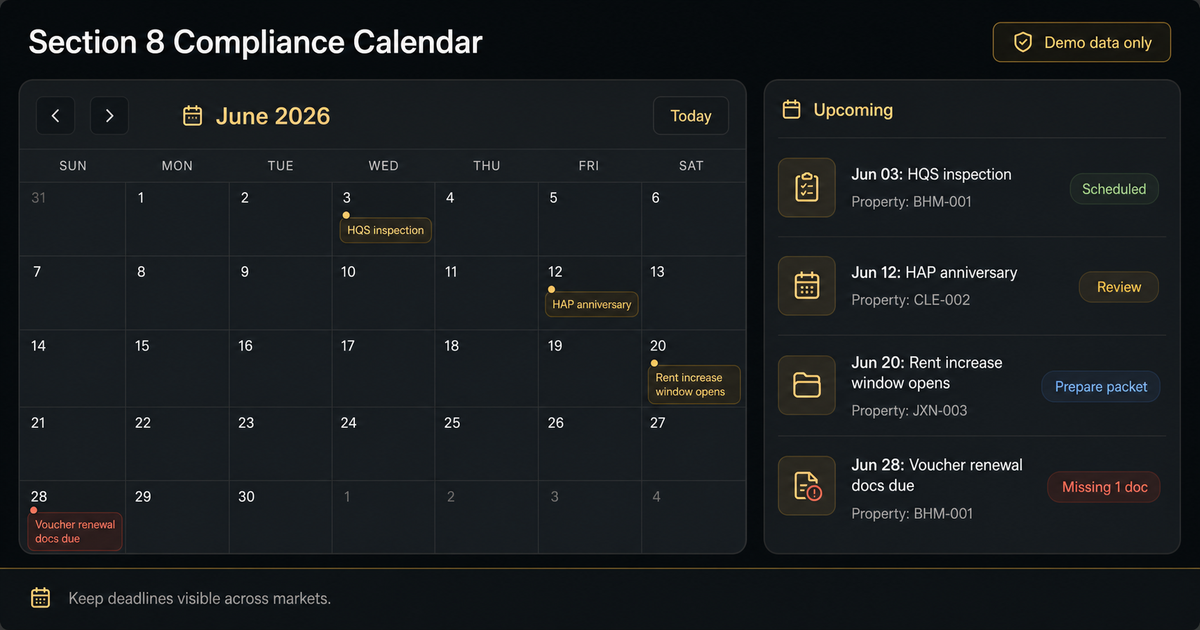
Build a clean compliance calendar
Track, per property:
- voucher type and bedroom size
- HAP contract anniversary date
- inspection dates and outcomes
- rent increase window and required documents
If you are new to this part, read: https://blog.doorvault.app/section-8-rent-increase-annual-window
Keep the paper trail in one place
Section 8 creates a lot of documents.
HAP contracts. inspection reports. rent reasonableness packets. lease addenda. renewal letters.
If you cannot find a document in 30 seconds, you do not have a system. You have a pile.
Tie operations back to performance
Your portfolio decisions should be driven by clean numbers:
- per property P and L
- market to market comparisons
- vacancy and turn costs
- recurring maintenance patterns
This is also why “remote ownership” content matters even for local investors. If you cannot run the owner side remotely, you are not scalable. Start here: https://blog.doorvault.app/how-to-manage-a-rental-property-remotely-when-you-have-a-property-manager-the-owner-checklist
How DoorVault keeps Section 8 portfolios clean when you use property managers
DoorVault is built for landlords who use property managers but still need control of the investor side.
Knox Intelligence is the layer that keeps the work from piling up.
The workflow is simple:
- Forward any property related email to your Knox inbox, upload documents, or sync a cloud folder
- Knox reads the documents, extracts the fields that matter, and files everything to the correct property
- If you want control, you can review proposed changes before they apply
- Every change is logged with an audit trail so you can see what moved and why
For Section 8 specifically, that means your market decision does not stop at “buy the property.” Once you are operating:
- voucher and HAP details stay structured per property
- inspections and deadlines stay visible
- PM statements get parsed so you can see where money is leaking
- portfolio reporting stays consistent across cities and LLCs
- year end export is a button, not a project
And because DoorVault runs the full owner side stack, you are not forced into ten different tools as you scale.
FAQ: best Section 8 markets (quick answers)
Where is the cheapest housing market right now?
“Cheapest” is not one market. It is a moving target and it depends on what you mean by cheap.
For Section 8 investors, the useful version is: where do acquisition prices stay low while voucher rents stay competitive. Use FMR to price ratio as your first filter, then validate inspections and PM coverage before you buy.
How many rental properties to make 5000 dollars a month?
It depends on your net cash flow per door after all expenses.
If your true cash flow is 250 dollars per month per property, you need about 20 doors to reach 5000 per month. If it is 150 per month, you need about 34 doors.
The lesson is not the exact number. The lesson is that clean bookkeeping and conservative underwriting matter more than hype.
Which rental business is most profitable?
There is no single winner. Section 8 can be reliable cash flow if you run the compliance and inspection workflow cleanly.
Pick the model you can execute consistently, then build systems so the owner side stays passive.
What is the 7 percent rule in real estate?
Most “rules” are shortcuts. They can be useful, but they can also hide the real math.
If a rule helps you quickly eliminate bad deals, use it. If it replaces real underwriting, ignore it.
For Section 8 and BRRR investors, focus on equity position, conservative rent assumptions, and a real cash flow floor. That is what keeps you alive when expenses jump.
The simplest next step
If you want to run Section 8 in more than one market, you need an owner side system that keeps documents, compliance, and performance in one place.
Start free. 2 properties. No credit card. → https://doorvault.app