
Federal 1031 deferral is only layer one.
The state tax record is where investors get cute. Then a notice shows up years later and everybody suddenly becomes a document historian.
Federal rules still matter. The IRS explains that a qualifying like kind exchange can defer gain, and that Section 1031 is now limited to real property. Fine. That is the headline rule.
The owner problem starts after that.
If you sell in one state, buy in another, move later, refinance later, sell the replacement later, or hand the file to a CPA who did not see the original exchange, the question is no longer “did this qualify federally?”
The question is uglier.
Can you prove what happened?
The exchange closes. The state file does not.
A 1031 exchange feels finished when the replacement property closes.
That is a lovely little lie.
Some states follow the federal deferral cleanly. Some require withholding. Some keep watching deferred gain that started inside their border. California is the classic example. Its Form 3840 instructions require annual reporting when California property is exchanged for out of state like kind property.
That is not trivia. That is a recurring owner record.
You need the relinquished property state. You need the sale date. You need the adjusted basis. You need the deferred gain. You need the replacement property. You need the annual filing trail. You need the final recognition event if the gain comes home to roost.
“My CPA probably has it” is not a system.
It is a shrug with billable hours attached.
The tax risk hides in 5 ordinary facts
Most state tax problems do not start with a dramatic mistake.
They start with 5 ordinary facts drifting apart:
- Where the relinquished property sat.
- Where the replacement property sits.
- What gain was deferred.
- Which forms were filed each year.
- Who can find the closing documents when the state asks.
That is the entire trap.
The federal exchange can be clean. The qualified intermediary can be real. The 45 day and 180 day windows can be met. The replacement property can be beautiful. The 1031 exchange record still needs to stay findable.
And the state record can still be a mess.
For an investor using property managers, the mess gets worse because the files do not live in one place. Settlement statements sit in email. PM statements sit in a portal. Loan records sit with the servicer. Tax packages sit with the CPA. The investor becomes the search engine.
Great. A portfolio and a side career in archaeology.
DoorVault treats the 1031 like an asset record
DoorVault does not replace your CPA. It does not replace your qualified intermediary. It should not. Those are regulated, professional jobs.
DoorVault handles the part owners keep underestimating.
The record.
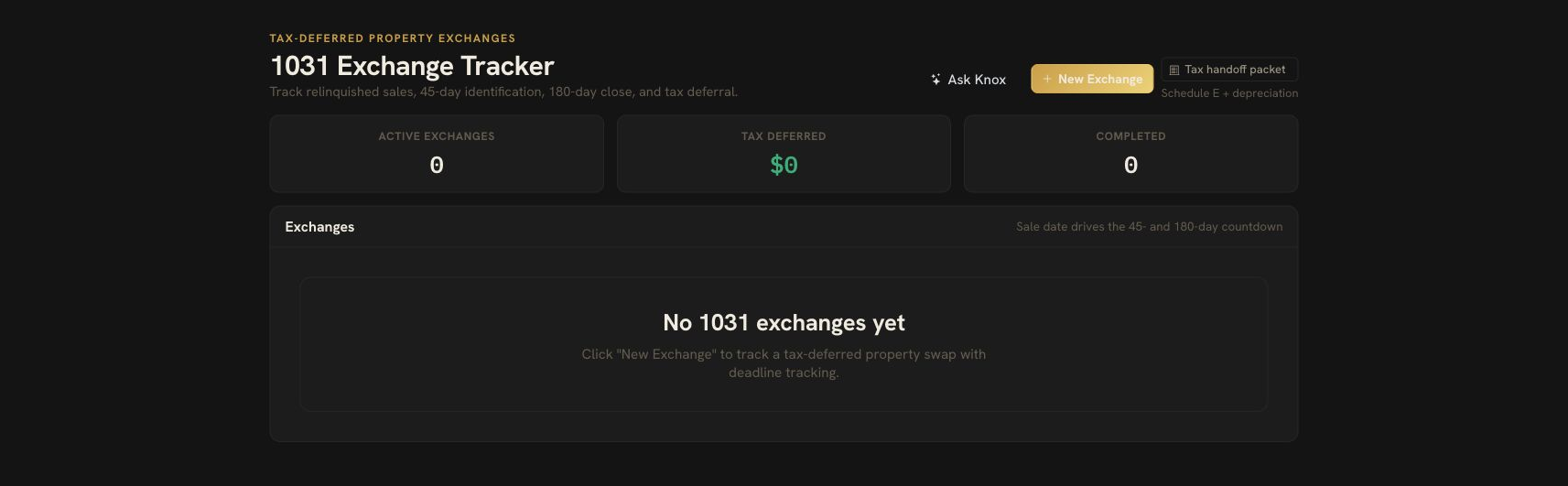
Inside DoorVault, a 1031 exchange can sit beside the property, documents, loan position, tax package, depreciation schedule, and portfolio view. Upload the closing documents. Keep the sale and replacement facts with the asset. Attach the CPA ready evidence. Track the exchange as part of the owner side system, not as a PDF you hope still exists in 2029.
Knox reads real estate documents and files them to the right property record. The tax package pulls the Schedule E and depreciation context into one handoff. The portfolio view keeps the replacement property tied to the rest of the owner record.
That is boring.
Good.
Boring is what you want when a state tax notice arrives.
Your CPA needs a packet, not a scavenger hunt.
The owner side handoff should answer the practical questions fast:
- What property was sold?
- What property replaced it?
- What was the deferred gain?
- Which state sourced the original gain?
- Which annual state forms were filed?
- Where are the settlement statements?
- Where is the depreciation and basis record?
- What happened when the replacement property sold?
If those answers live in 6 places, tax season becomes theater.
The CPA asks for documents. You search email. The PM portal does not help. The closing folder has 4 files named final. The spreadsheet has the old basis because nobody updated it after improvements.
Then everyone pretends this was unpredictable.
It was not unpredictable. It was untracked.

The 2026 checklist is not fancy
Here is the owner checklist before and after a state sensitive 1031:
- Save the relinquished closing statement.
- Save the replacement closing statement.
- Record the state for both properties.
- Record the deferred gain and basis.
- Save the qualified intermediary file.
- Track any required annual state form.
- Keep the CPA packet with the asset record.
- Update the record when the replacement property sells.
No magic.
Just the facts a state tax agency can ask about after your memory has moved on.
This is why DoorVault’s broader platform matters. The 1031 record is not isolated. It touches documents, tax package generation, depreciation, loans, equity, PM statements, and portfolio decisions. The state tax question sits inside the asset management system, because that is where the evidence lives.
The property manager runs the property.
The owner still has to run the asset.
The mistake is treating state tax as a one time question
“Can I do a 1031 between states?” is the wrong final question.
Ask the CPA before you do it, obviously.
Then ask the owner side question:
What record will prove this exchange every year until the gain is finally recognized?
That question is less fun. It is also the one that saves you from hunting for a 7 year old closing statement while a state letter sits on your desk.
Federal deferral gets the attention. State conformity gets the surprise. The record gets ignored.
That is the part DoorVault fixes.
Track the exchange, documents, tax package, basis, depreciation, loans, equity, and property history in one owner side system.
Start at https://doorvault.app.